Email triage means deciding what a message needs before doing all the work it contains. Give each message a next action: reply, schedule work, wait for someone, keep for reference or remove when appropriate. Then use a separate work window for messages that require more than a quick response.
Start with a bounded batch, such as messages received since yesterday or the oldest unresolved conversation with a current deadline. Trying to redesign years of email while an important request waits can turn inbox cleanup into another unfinished project.
Check whether the message is safe and relevant
Treat unexpected requests for passwords, money or sensitive documents with care. Verify a suspicious request through a trusted channel you already know, rather than using contact details supplied in that same message. Follow your workplace's reporting process when one exists.
For ordinary mail, ask whether it relates to a current responsibility, a decision you need to make or a record you need to keep. Marketing mail you no longer want may belong in an unsubscribe process. Records covered by workplace retention rules need to follow those rules even if they no longer feel useful to you.
Identify the requested action
Read for a question, deliverable or decision. If the action is unclear, send a focused clarification: "Do you need comments on the draft, or approval to publish it?" If several requests are bundled together, list them separately in your task system or response.
A message that only shares information can usually leave the active inbox once you have read it and decided where it belongs. In Gmail, archiving removes a message from the inbox while keeping it available in All Mail; deletion follows a different path. Check your email app's behavior before using the buttons interchangeably.
Reply now only when the work really fits
A short acknowledgment or answer may fit in the current triage session. A reply that needs research, calculations or a conversation is a task. Put that work in your planning system with a link or enough context to find the original message.
Avoid imposing a universal two-minute rule on every inbox. The right threshold depends on the time you reserved and how much mail is waiting. If one reply starts expanding, stop and schedule it instead of letting it consume the whole review.
Track waiting messages differently
When you need another person's answer, record what you are waiting for and when you will check again. A waiting list can be a label, a task or a small note. Choose one place you already use and make the entry specific enough to understand later.
Snoozing can return a message at a chosen time in Gmail. Use that when you genuinely want to revisit the message, and remember that it does not make the other person respond. If the dependency affects a deadline, communicate that separately.
Keep reference out of the action queue
A receipt, completed agreement or useful explanation may need to be retained without staying in the inbox. Use labels, folders or search conventions that you can remember. A complicated taxonomy is only useful if you can apply it consistently and find things again.
For a completed conversation, check that any commitments are recorded elsewhere before archiving. Otherwise the message may disappear from view while the action remains only in your memory.
End the session with the work visible
Review the tasks you created and compare them with your available time. Triage can reveal more work than you can complete today. Choose an order, renegotiate deadlines where necessary and send acknowledgments when people need to know what to expect.
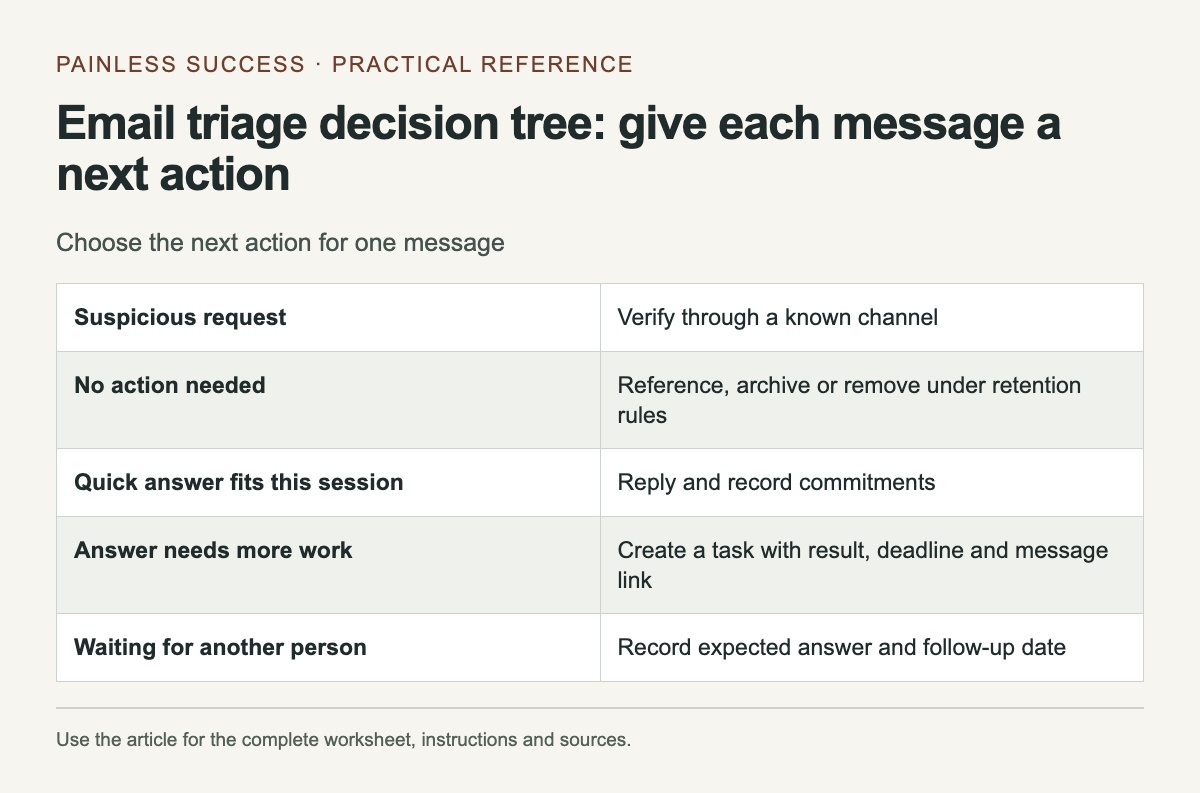
The decision tree below is meant to be used one message at a time. Open the branch that matches the message, choose the action and move on. An empty inbox is optional; a reliable place for unresolved work is what makes the next review easier.
One-message decision tree
The request looks suspicious
Pause. Verify through a known channel and use your organization's reporting process.
No action is required
Keep necessary records in reference, archive ordinary information, or remove unwanted mail according to your retention rules.
I can answer within this triage session
Reply, record any commitment and move the completed conversation out of the active queue.
The answer needs work
Create a task with the requested result, deadline and link to the message. Give it a work window.
I am waiting for another person
Record the expected answer and follow-up date. Communicate any deadline affected by the dependency.
Capture the message action
Your notes stay in this page. Copy them before leaving; they are not saved or sent to us.