Draft for editorial review · English · Prepared 29 October 2026 · Not published
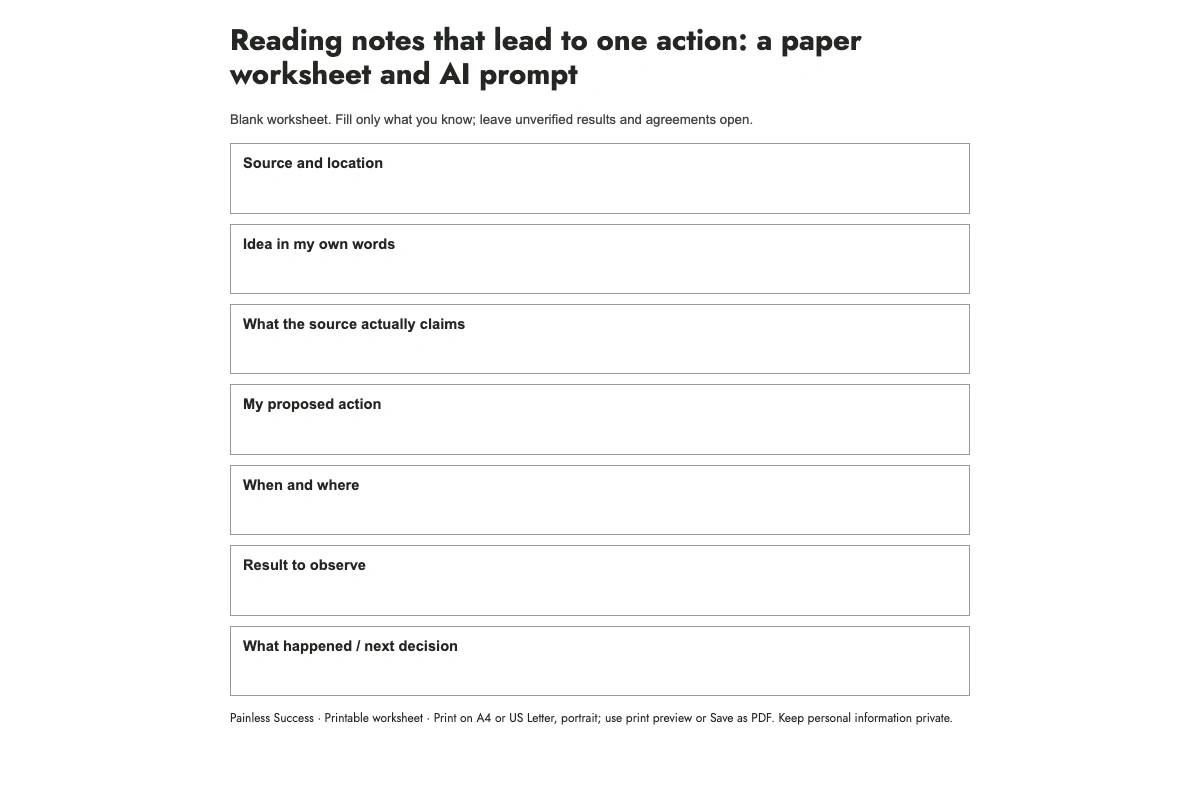
Blank printable · Filled example · Complete prompt
On one sheet, record where a reading idea came from, what you think it means and one thing you will try. Keep the author’s point separate from your own application so you can return to the passage and check either later.
In this invented example, a practice note suggests keeping frequently used supplies together. The reader writes: “Before my next drawing session, place three pencils beside the sketchbook. Observe whether I can start without searching for a pencil.” The result stays “not tried yet.” Leave the result open until you have tried the change.
Choose a passage with a possible use
Start with a paragraph you have actually read, rather than a whole book you would like AI to summarize. Record the title and a location you can find again. Use the page number from your edition, a chapter heading, or a link and section title. If the location is uncertain, leave a question mark instead of filling the space from memory.
Then write the idea in your own words. A paraphrase should not sit inside quotation marks. If you want an exact quotation, check every word against the source and keep the extract short. You can make a useful action card from your own paraphrase without copying a long passage into an AI service.
Not every passage needs an action. A novel, historical account or poem may be worth reading without producing a task. Use this sheet when you already want to apply an idea, and keep ordinary reading notes elsewhere. Otherwise the worksheet becomes an obligation attached to everything you read.
Separate the claim from your experiment
In the filled example, the source proposes grouping supplies. The reader chooses a kitchen table and three pencils. Those details are an application, not an instruction attributed to the source. Put them in different boxes so a later review does not turn your practical choice into something the author supposedly said.
I would choose an action small enough to try during an activity already planned. “Reorganize my creative life” offers no useful starting point. “Put these pencils beside this sketchbook” does. A smaller action also gives you a clearer thing to inspect when the result disappoints.
Add an observation before you act. It might be whether a file is easier to find, whether an opening paragraph contains the promised information, or whether you remember to bring the required materials. Avoid turning a single personal trial into a general conclusion. One convenient session can justify keeping an arrangement without proving that it works for everybody.
Give AI a formatting job
Paste the complete prompt below with the fictional notes to practice. For your own use, replace the notes with a short paraphrase and the source location. Do not paste confidential reading material or unpublished work that you are not permitted to share.
Organize these invented reading notes into one action card. Use only the supplied notes. Return source ID, paraphrase, proposed action, observation and unknowns. Keep the source claim separate from my interpretation. Do not invent quotations, page numbers, research findings or completed results. Do not buy, schedule or change anything.
R1: Fictional practice note, paragraph 2: keeping frequently used supplies together is suggested as a way to reduce searching. No measurement is supplied.
R2: My proposed application: place three drawing pencils beside the sketchbook before the next kitchen-table drawing session.
R3: Observe whether I start without searching for a pencil. I have not tried this yet.
Keep the action within R2. If the evidence cannot support a claim, mark it unsupported.
The useful output is a compact card with a source ID beside the paraphrase and “not tried” beside the outcome. Reject an answer that claims the arrangement saves a particular number of minutes. No such measurement appears in the notes. Also reject an invented page reference, even if it makes the card look complete.
OpenAI's prompting guidance recommends clear context and reviewing the response. Here, the narrow task is deliberate: organize supplied notes, preserve the distinction between claim and application, and expose missing information. You remain responsible for checking the passage and trying the action.
Print the card and do the physical step
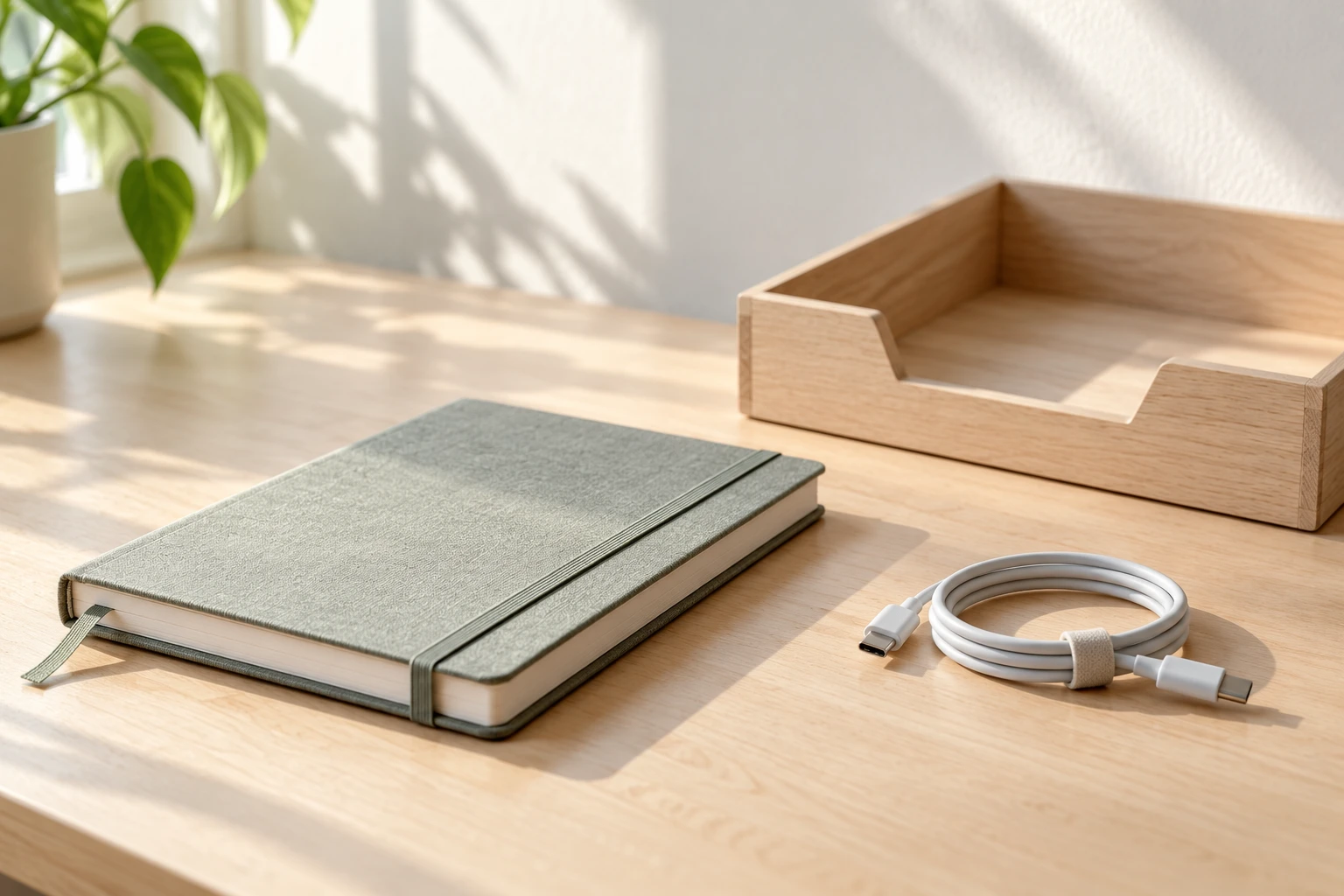
Use the blank worksheet for your own reading or print the filled example beside it. Keep the sheet where you will use it: a card about preparing drawing materials belongs near the sketchbook and pencils.
Before the next session, do the proposed step. Afterwards, jot down what happened: “Started without searching; forgot eraser.” If you normally need the eraser, add it to the setup. You can make that adjustment directly without asking AI to redesign the routine.
If the action did not happen, record the obstacle separately from the outcome. “Shared table unavailable” tells you the setup was not tested. “Pencils ready but chose another activity” tells you preparation was not the only constraint. Neither entry means the original passage was false.
Keep, change or set aside
At review, choose one of three decisions: keep the arrangement, change one part, or set the card aside. Write why in a sentence. Keep the original source reference even if you change the action; otherwise you lose the trail between what you read and what you learned from using it.
A growing stack of untried cards is a reason to stop creating new ones. Select one card that still matters and archive the rest without promising to catch up. If two cards suggest incompatible changes, choose the one that fits the activity you are actually doing now.
AI can help shorten your result note, but it should not turn “one session went smoothly” into “this method is proven.” OpenAI's accuracy guidance notes that confident output can still be wrong. Compare any rewritten conclusion with your observation before keeping it.
For deciding what belongs on the reading list in the first place, use a reading list that moves. For keeping one idea in practice over several sessions, continue with keeping one lesson active.
More practical tools
Unstick a task or compare two options. Fill in your own details, then print the result or download your notes.