Draft for editorial review · English · Prepared 29 October 2026 · Not published
Blank printable · Filled example · Complete prompt
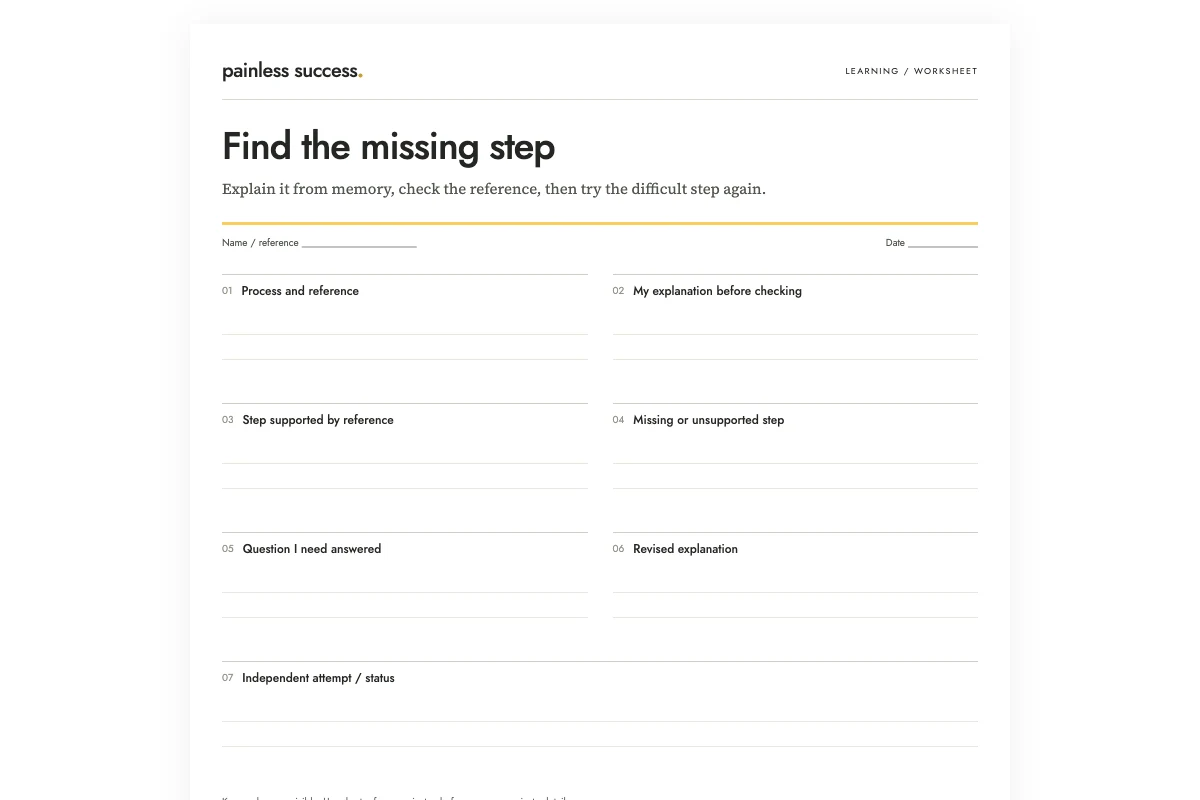
Write your explanation of a process before looking at the supplied reference. Then compare the steps and the conditions that change them, including exceptions. Mark where your explanation breaks down and turn that gap into a question to investigate. Fluent wording alone does not establish understanding.
Consider an invented badge-sorting exercise. Intact round badges go in tray A, intact square badges go in tray B, and any cracked badge goes in a repair tray. A learner explains, “Put all round badges in A and square badges in B.” The explanation sounds complete until you compare it with the exception. The worksheet marks the missing crack check rather than describing the learner as careless.
Choose a process with a checkable reference
Use a short procedure, rule or worked explanation from material you are allowed to use. A few connected steps are enough. If the reference itself is unclear or incomplete, note that before treating it as an answer key. You cannot settle a missing rule merely by producing a smoother explanation.
Keep the first attempt low stakes. The fictional sorting exercise uses paper shapes or written labels. For real work involving safety, medical decisions, equipment or other consequential actions, follow the appropriate instructions and supervision. A self-explanation sheet does not authorize trying an uncertain procedure.
Record the reference location and version. If your explanation is checked against different instructions later, you need to know which set applied. The reference can be a teacher's supplied example, but record it accurately rather than relying on what you think you remember hearing.
Explain before you edit
Cover the reference and write how you think the process works. Use ordinary language. Include what starts the process, what you do next and what changes the choice. If you reach a step you cannot explain, write a question mark there instead of filling it with a guess.
Write the first attempt yourself. If AI composes it, you can only judge whether its answer looks familiar; you will have no record of how you explained the process.
You can speak the explanation and then write a short summary if that suits you better. There is no need to record or upload audio. Keep hesitations that reveal uncertainty, such as “I am not sure whether this exception comes first.” Those are useful working notes, not defects to remove immediately.
Compare meaning rather than matching wording
Uncover the reference and check each substantive statement. Different words can describe the same step, while similar words can hide a changed condition. In the example, “all round badges” conflicts with the rule for cracked badges. The important difference is the missing exception, not the absence of the word “intact.”
Use three marks: supported, missing, and added without support. A missing step belongs in the reference but not your explanation. An unsupported addition appears in your explanation without a basis in the reference. Keep those categories separate because they require different corrections.
Do not assume that an unmentioned case has an obvious answer. The fictional rules do not cover intact triangular badges. A complete account of the supplied instructions should preserve that gap. “Other shapes need clarification” is more faithful than inventing a tray C.
Ask AI for a bounded comparison
Try the fictional notes in this prompt first. Check that AI compares the explanation with the reference and avoids adding a sorting lesson or judging the learner.
Compare my explanation with the supplied fictional reference. Do not add outside rules. Return supported steps, missing conditions, unsupported additions and one precise question. Cite R IDs. Do not rewrite my explanation until after listing the gaps. Do not assess intelligence, competence or learning style. Do not claim this checks performance on a real task.
R1: Intact round badges go in tray A.
R2: Any cracked badge goes in the repair tray, regardless of shape.
R3: Intact square badges go in tray B. Other shapes are not covered by these instructions.
E1: My explanation: “Put all round badges in tray A, and square badges in tray B.”
Then offer a short revised explanation labelled suggested. Keep other shapes unresolved. Draft only; do not operate equipment or modify any records.
Look for a source ID beside each correction. The output should identify the crack exception from R2 and leave other shapes unresolved under R3. If it says the learner “does not understand priorities,” replace that broad judgment with the actual omission.
OpenAI's accuracy guidance warns that generated answers can be mistaken. Check the gaps the model identifies against the reference yourself. Treat them as suggestions to inspect, since the model is not an independent authority on the exercise.
Turn the first useful gap into a question
A broad request such as “Explain this again” can produce another long answer. Ask about the step you cannot connect: “Should the crack check happen before choosing a tray by shape?” If the reference resolves it, write the answer and its location. If it does not, take the question to the person responsible for the material.
Choose a question that blocks the next step rather than collecting every possible uncertainty. In the example, the exception affects the handling of a round badge, so it deserves attention before discussing an uncovered shape that is not present in the exercise.
I would keep both versions side by side and note what changed, such as “added exception before shape choice.” You can then return to the correction at the next session without reconstructing it from the finished paragraph.
Try again without copying the revision
After reviewing the correction, cover the reference and the revised text. Explain the process again or work through a new fictional example supplied by your teacher or material. Record the attempt separately from the first one. Do not overwrite the original evidence.
A clear second explanation is a result for this attempt. It does not establish that you can perform every real task covered by the topic. If practical performance matters, use the relevant task checks as well. Explaining the steps and carrying them out are different things to observe.
If you remain stuck, narrow the explanation. Work on the condition that changes the next action rather than restarting the entire topic. Bring the two versions and your precise question when asking for help; the other person can then see where the connection breaks.
For selecting a focused practice question, see practising with a question. For getting help on the specific unresolved part, use asking for feedback on one part.
More practical tools
Unstick a task or compare two options. Fill in your own details, then print the result or download your notes.