A time block reserves a place in your calendar for an activity. A timebox sets a limit on how long you will spend on it before stopping or reviewing what to do next. You can use both: reserve 2:00 to 3:00 for a report, then give its opening section a 20-minute timebox.
The difference matters when a task keeps expanding. A calendar entry saying "work on report" protects an hour, but leaves you to decide what should happen inside it. A timebox saying "draft the opening for 20 minutes, then mark the gaps" gives that hour a smaller finish line.
Start with the problem in your calendar
Use a block when the activity needs a place in the day. This might be reading, concentrated work or collecting someone from an appointment. Include preparation and travel where they belong. Reserving 30 minutes for a 30-minute appointment across town leaves an obvious gap in the plan.
Use a timebox when you need to limit an open-ended activity. Looking for a presentation image, sorting old files and comparing notebook apps can absorb whatever time is available. Decide in advance what you will do when the timer ends: choose from the options found, record a question, or ask for more time.
Some work needs a firm completion standard. A timebox does not make an incomplete safety check, application or required review finished. It tells you when to reassess the remaining work and the deadline. Keep the completion standard separate from your time limit.
A worked afternoon schedule
Suppose you have an illustrative two-hour window before a call. Reserve 1:00 to 2:10 for a draft, 2:10 to 2:25 for a break and messages, and 2:25 to 3:00 for call preparation. Within the draft block, use 15 minutes to outline, 40 minutes to write and 15 minutes to mark missing information.
The draft may still need work at 2:10. Leave a note naming the unfinished section and its next action. Then decide whether the deadline permits a later block. If the draft must be complete today, something else needs to move; changing the label on the calendar will not create the missing time.
This schedule is a planning example, not a recommended ratio. A task that requires reading a difficult document may need a longer uninterrupted block. A short administrative task may need only an end time.
Decide what the timer means
Write a stopping rule beside the task. "At the bell, save the file and list unanswered questions" is clear. "Work faster" gives you no decision to make. If another person is waiting for a result, agree on what you can deliver within the time available.
The Scrum Guide uses timeboxes for specific team events. That is one formal application of a time limit; it does not establish the ideal length for your personal writing session. Choose your first duration from the task and your available window, then compare the plan with what happened.
Recover when the day moves
Leave a small gap between activities when transitions regularly take time. If a call overruns, update the next block once. Avoid spending the remaining afternoon repeatedly dragging calendar rectangles into a perfect arrangement.
After a few attempts, check whether your blocks are protecting useful work and whether your timeboxes end with an actionable note. A calendar that makes every ordinary interruption look like failure needs revision. Keep appointments that involve others visible, move flexible work deliberately and tell anyone whose agreed deadline changes.
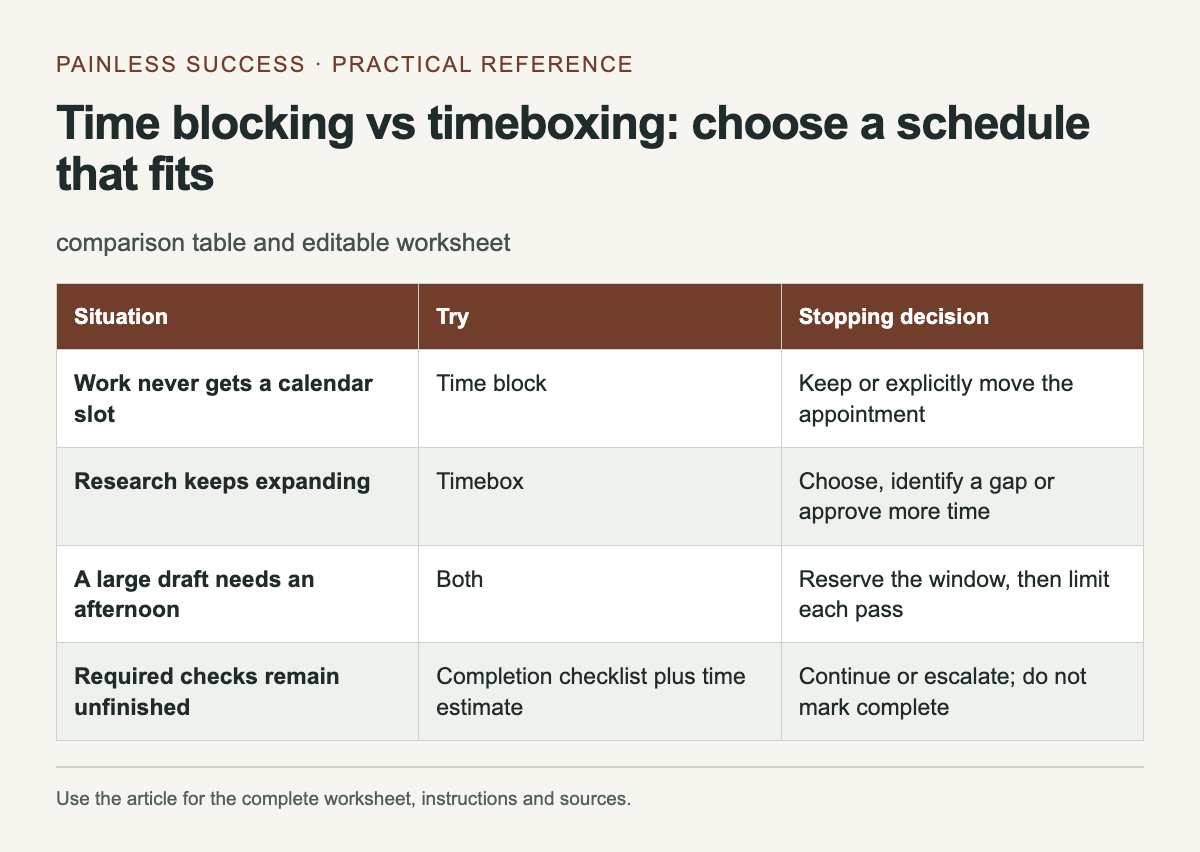
| Situation | Try | Stopping decision |
|---|---|---|
| Work never gets a calendar slot | Time block | Keep or explicitly move the appointment |
| Research keeps expanding | Timebox | Choose, identify a gap or approve more time |
| A large draft needs an afternoon | Both | Reserve the window, then limit each pass |
| Required checks remain unfinished | Completion checklist plus time estimate | Continue or escalate; do not mark complete |
Plan one session
Your notes stay in this page. Copy them before leaving; they are not saved or sent to us.