A cleaning checklist becomes easier to use when it names the work that fits into the time you actually have. Start with this filled example: a 25-minute household reset, 21 minutes of estimated tasks and four minutes left unassigned. AI can arrange the notes; the paper sheet stays beside you while you do the work.
I would begin with one short session. A whole-house schedule asks you to guess too many durations at once. After a few sessions, your own notes will tell you which estimates need changing. If several people share the work, agree who owns each task before treating the list as a plan.
Print the blank checklist · Print the filled example · Download the complete prompt. The sheets support A4 and US Letter in portrait and your browser’s Save as PDF option.
1. List the visible tasks and your time limit
Walk through the rooms you intend to cover. Write small actions: “put away dry dishes” is easier to check than “sort out the kitchen.” Add an estimate beside each action and a priority. You can use A for the work you want done first and B or C for work that can wait.
Keep surface-care and appliance instructions with the relevant task. This article organizes work; it does not prescribe cleaning products or treatments. If a surface needs an unfamiliar method, leave that task pending until you have checked its care instructions. A model should not fill that gap with a confident guess.
2. Paste this complete example into your AI assistant
The following household and timings are invented for practice. You can use the prompt unchanged to see whether the assistant preserves the budget and leaves tasks unchecked. No account connection, calendar access or file upload is needed for this text-only exercise.
OpenAI’s prompting guidance recommends clear instructions, enough context and revising the answer after review. Here, the task list and time rule provide that context.
Make a printable cleaning checklist from these invented practice notes. Use only the supplied tasks. Group by room; preserve time estimates as estimates, not measured durations. Return columns: room, task, minutes, priority, done. Leave all done boxes empty. Add the estimated total and a separate deferred list. Do not invent cleaning products, chemical combinations, surface-care instructions, household members or completed work. Draft text only; do not order supplies, set reminders or contact anyone.
N1: Available time: 25 minutes. One person will work. These estimates include getting ordinary supplies ready.
N2: Kitchen: put away dry dishes, 4 minutes, priority A; wipe the cleared table using its existing care instructions, 5 minutes, priority A.
N3: Living room: return books to the shelf, 4 minutes, priority B; vacuum accessible floor using the appliance instructions, 8 minutes, priority B.
N4: Bedroom: fold the dry towels, 7 minutes, priority C.
N5: Keep 4 minutes of the 25-minute slot unassigned. Choose A tasks first, then B; defer C if it will not fit.
N6: These are planning estimates only. Mark any unknown as unknown. Do not claim the rooms are clean.
After the table, identify what I must check before using it.
3. Compare the answer with this worked checklist
| Room | Task | Estimated minutes | Priority |
|---|---|---|---|
| Kitchen | Put away dry dishes | 4 | A |
| Kitchen | Wipe cleared table | 5 | A |
| Living room | Return books | 4 | B |
| Living room | Vacuum accessible floor | 8 | B |
The four selected tasks total 21 minutes: 4 + 5 + 4 + 8. Together with the four-minute buffer, they occupy the 25-minute slot. Folding the towels takes an estimated seven additional minutes, so it stays on the deferred list. It has not disappeared and it has not been completed.
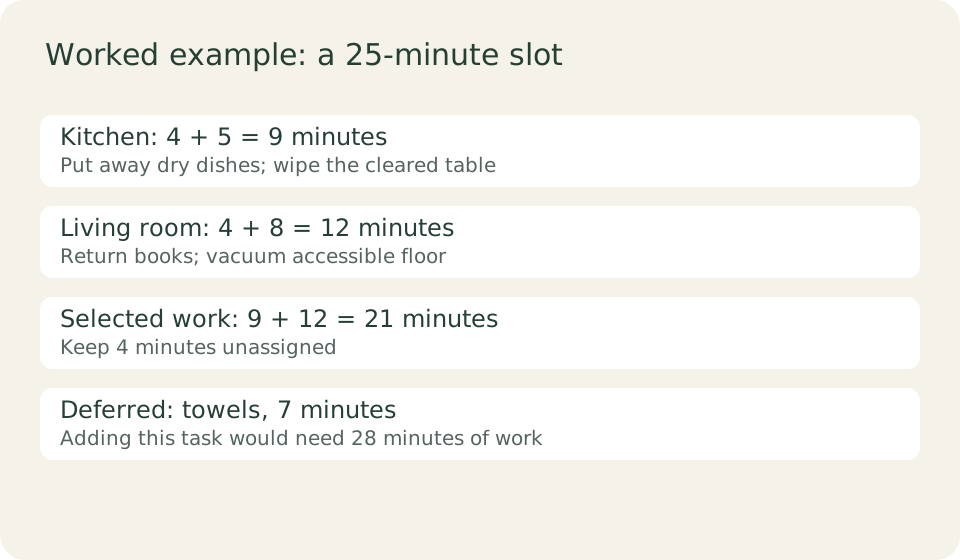
This is a prepared example of a checked result, not a transcript of a test run. An assistant might format the answer differently. Check that it includes the same four tasks, the same estimates and the separate towels item. A polished answer that squeezes in every task fails the time constraint.
4. Print the sheet and mark actual progress
- Choose the filled sheet for practice or copy your checked tasks onto the blank sheet.
- Write the date and your available time. Keep the buffer visible.
- Follow the care instructions already appropriate for each task. Leave an unfamiliar or unsuitable task pending.
- Tick a box only after doing that action. If you stop midway, record what remains instead of ticking the whole row.
- At the end of the slot, note which estimate was far off and move unfinished work to a later list.
I would change the estimate for one repeated task after each session. That keeps the next checklist grounded in what happened without turning a household reset into detailed time tracking. If interruptions are common, shorten the selected task list or reserve a larger buffer.
5. Catch these errors before reusing the list
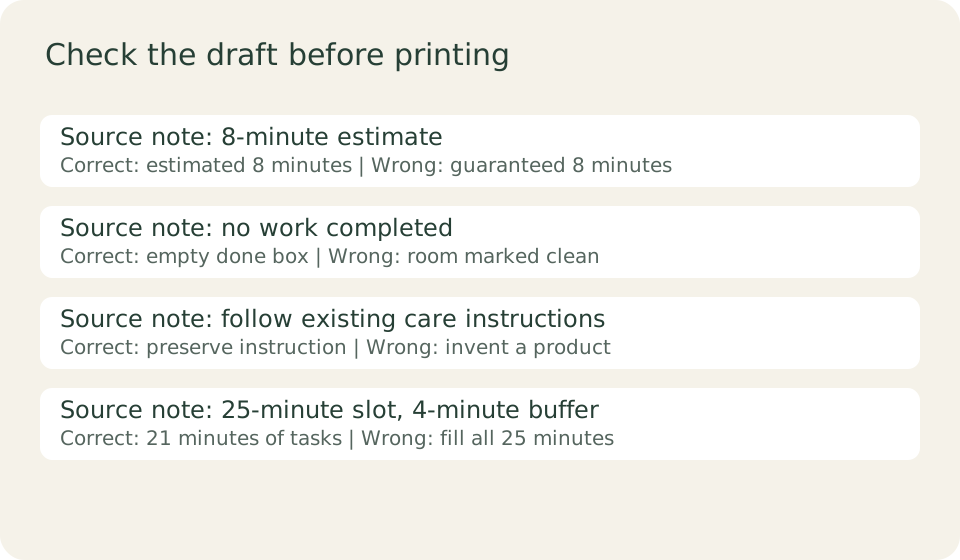
OpenAI’s accuracy guidance notes that confident answers can still be wrong. In this workflow, inspect the ordinary details: a guessed product, an invented household member, an estimate rewritten as a promise or a checked box that nobody earned.
When you replace the practice notes with your own, omit addresses and private household details that the task does not need. Ask for a revision if the output loses a constraint. Keep recurring schedules tentative until the people doing the work agree to them.
For a larger plan, use the paper and AI weekly planning guide. If you give an agent tools, use an explicit task brief so generating a checklist does not also trigger reminders, purchases or messages.