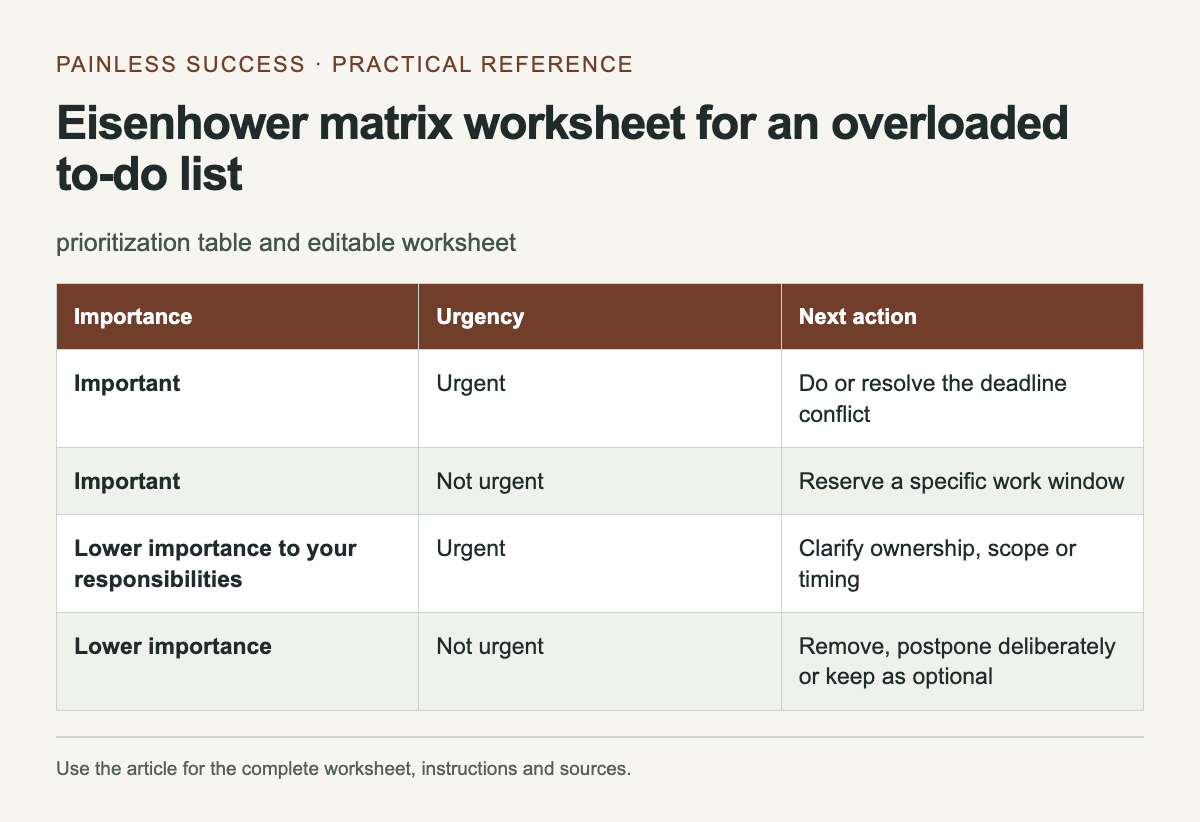
The Eisenhower matrix sorts tasks by two questions: does this need attention soon, and does it matter to a goal or responsibility? Put each task into one of four groups, then choose an action. The useful part is naming the deadline and consequence behind the label.
A request marked "urgent" can still have an unclear deadline. A task without a deadline can carry a real responsibility. Before sorting your list, turn broad entries such as "website" into actions such as "send the corrected opening hours for approval."
Define importance before looking at messages
Write down what you are responsible for this week. Include commitments to other people, routine maintenance and personal plans you intend to protect. Without that reference, importance can drift toward whichever message arrived most recently.
For each task, finish the sentence "This matters because..." An answer could be that a colleague cannot proceed, a promised delivery is due, or a recurring problem needs prevention. "It has been on my list for ages" tells you about its age, but does not explain its value.
Avoid turning the matrix into a judgment about people. A colleague's request may be important to them while needing someone else's ownership. Record who can decide or help before moving it out of your own queue.
Give urgency a date and a consequence
Ask what changes if the task waits until tomorrow or next week. A booked appointment, a published deadline and a blocked handover create different kinds of time pressure. Write the actual date where one exists. If someone only says "soon," ask when they need the result and what depends on it.
Some tasks are urgent because they have already been delayed. The immediate task still needs attention. Afterward, add any preventive step to the important, nonurgent group rather than leaving the same emergency to recur.
Use the four groups without assuming you can delegate
Atlassian describes the matrix as four quadrants based on urgency and importance. The familiar actions are do, schedule, delegate and remove. In an individual workload, delegation may not be available. A more useful response can be clarifying ownership, reducing scope or negotiating a deadline.
Consider an illustrative list with a correction due at noon, preparation for next week's interview, a request for an old file and an optional notification cleanup. The correction has a concrete near-term consequence. Interview preparation needs a reserved session before it becomes urgent. The file request needs an owner and a real due time. Notification cleanup can wait if it has no current benefit.
Resolve a crowded urgent-and-important box
If six tasks belong in the first group, the grid has identified a conflict. It has not solved your capacity problem. Estimate what each requires, identify fixed deadlines and ask the relevant person to choose between competing commitments.
A useful message is: "These two items each need about an hour, and both are due at three. Which takes priority, and can the other move to four?" Add uncertainty if you have never done the task before. Protect work with serious consequences even when it is less visible than a noisy request.
Review the decisions, not the appearance of the grid
End with a next action and review time for each active item. A task in "schedule" needs an actual slot. A task in "clarify" needs a named person and question. When you remove an optional task, delete or archive it so it does not return as an unexplained obligation.
Revisit the matrix when a deadline or responsibility changes. Keeping yesterday's labels perfectly organized is less useful than noticing that today's information changes the order.
| Importance | Urgency | Next action |
|---|---|---|
| Important | Urgent | Do or resolve the deadline conflict |
| Important | Not urgent | Reserve a specific work window |
| Lower importance to your responsibilities | Urgent | Clarify ownership, scope or timing |
| Lower importance | Not urgent | Remove, postpone deliberately or keep as optional |
Your four-quadrant worksheet
Your notes stay in this page. Copy them before leaving; they are not saved or sent to us.