Draft for editorial review · English · Prepared 29 October 2026 · Not published
Blank printable · Filled example · Complete prompt
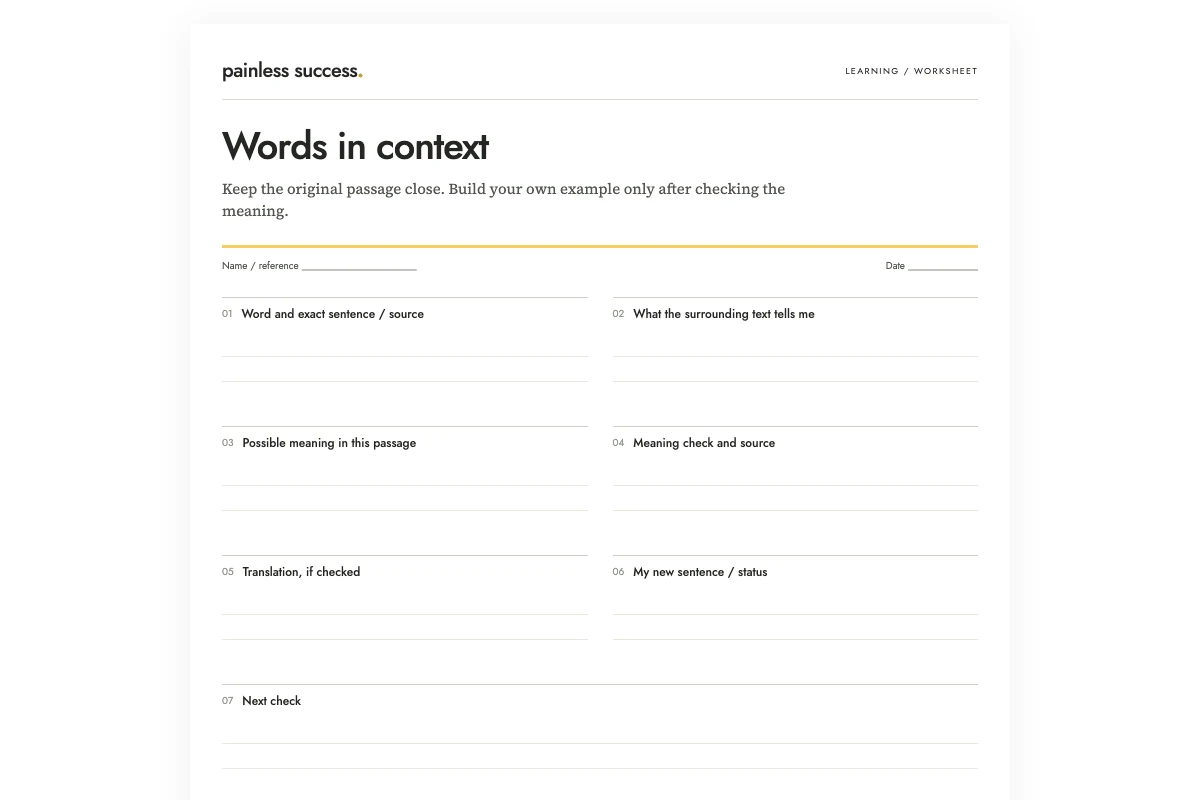
Keep the sentence where you met a word on the same card as its meaning. Note the clues around it and leave room to record how you checked the definition. AI can arrange the card, but its proposed explanation still needs that check.
Start with this invented passage: “At the library desk, the assistant said, ‘You can reserve the atlas for collection tomorrow.’ The visitor wrote down the collection time and left without the atlas.” A card for reserve might say “put aside for later collection.” That is an editorial interpretation of the passage. The dictionary-check and translation fields remain blank until you check them.
Pick a passage short enough to inspect
Use a few sentences you can read beside the card. The source could be your own writing, an exercise you are allowed to use, or a short extract from reading material. Record a location that will still make sense later: a page, paragraph, exercise number or stable link.
A screenshot without a source name is easy to lose track of. If you photograph a page for your own notes, write the source on the paper card as well. Before sharing an extract with AI, remove unrelated personal information and check that you are permitted to share the material. A short transcription is often all the tool needs.
Choose one or two words that you need to understand or want to use. Making a card for every unfamiliar word can leave you with a large filing task, so choose by the sentence you want to examine rather than a daily card target.
Copy the sentence before explaining the word
Keep the original wording in one clearly marked field. Do not allow AI to improve the sentence while quoting it. In the library example, changing “for collection tomorrow” to “until tomorrow” could alter the situation you are trying to understand.
Write the surrounding clues separately. The visitor leaves without the atlas and has a collection time. Those details support a reading of the exchange. They do not supply a complete dictionary entry, pronunciation guide or list of every possible use of the word.
This separation is especially useful when a word is familiar in another setting. You may already know a meaning that does not fit the passage. Ask what the surrounding sentences support here, and keep other senses off this card unless you deliberately start a comparison.
Use the prompt to preserve uncertainty
Try this prompt with the fictional passage. Check that the card reproduces the sentence exactly, labels the explanation tentative and leaves verification open.
Make one vocabulary context card using only the fictional passage below. Target word: reserve. Fields: exact sentence with source ID, contextual clues, tentative meaning, independent meaning-check status, translation-check status, and a question to resolve. Do not invent a dictionary citation or claim the meaning is verified. Do not translate. Do not add other meanings of the word. Do not generate a quiz or mark anything learned.
P1: At the library desk, the assistant said, “You can reserve the atlas for collection tomorrow.”
P2: The visitor wrote down the collection time and left without the atlas.
P3: No dictionary entry or translation has been supplied.
Keep the quotation exact. Label the meaning an interpretation of this passage, not a verified dictionary definition. Draft text only.
Review the quotation letter by letter against the supplied sentence. Then look at the proposed meaning. Does it fit the action described, or has the model imported a different setting? If it cites a dictionary you did not provide and it did not inspect, remove that citation. It is not evidence of a completed check.
OpenAI's accuracy guidance notes that generated information can be wrong even when the language sounds certain. A card that you intend to reuse deserves a careful first check. Reformatting a guess several times does not make it more reliable.
Check the meaning through an appropriate reference
Use a dictionary, course glossary or teacher's explanation that fits the language and level you are studying. Find the relevant sense rather than copying the first definition you see. Record the reference and, where useful, the sense or entry that supports your interpretation.
If the reference does not resolve the passage, write the remaining question. Perhaps the word appears in an idiom, or the surrounding paragraph is needed. Keep the card in an unchecked group instead of forcing a definition into the space. You can still continue reading with the uncertainty marked.
For a translation, add a separate check. The original passage may support an English explanation without establishing a natural equivalent in your other language. Do not label an AI translation correct simply because the English explanation looks reasonable. A bilingual reference or a knowledgeable teacher may help resolve the particular usage.
Add one sentence of your own
After checking the meaning, write a short sentence that uses the same sense. In the example, “Can I reserve the guide?” is an invented practice sentence. It is not another quotation from the passage and is not automatically correct because it resembles the original.
Mark your sentence as your attempt. If someone checks it, record the correction and its source. If no check is available, leave that status visible. This is more informative than a tick that could mean “written,” “reviewed” or “remembered,” depending on the day.
I would keep the new sentence close to an ordinary situation you might actually describe. A complicated sentence can introduce several grammar questions at once. A short attempt makes it easier to ask whether this particular use of the word is suitable.
Use the paper card without hiding the evidence
Print the blank sheet for your own passage or use the filled example as a model. Cover the explanation when you want to attempt it yourself, then uncover both the explanation and its checking status. An unchecked interpretation should remain visibly unchecked even when you are using the card for practice.
Write the date of an attempt and what you produced, leaving room for the next check. Avoid marking a word permanently “learned” after one response. No particular card schedule is claimed here to guarantee retention.
If several cards remain unresolved, take one precise question to your next lesson. “Does this sense fit this sentence?” gives the other person something concrete to inspect. A pile of unexplained words is harder to discuss than a sentence with its context intact.
For a different task, making practice questions from notes provides a structured question workflow. To choose which item stays active in your practice, see keeping one lesson active.
More practical tools
Unstick a task or compare two options. Fill in your own details, then print the result or download your notes.