Draft for editorial review · English · Prepared 29 October 2026 · Not published
Blank printable · Filled example · Complete prompt
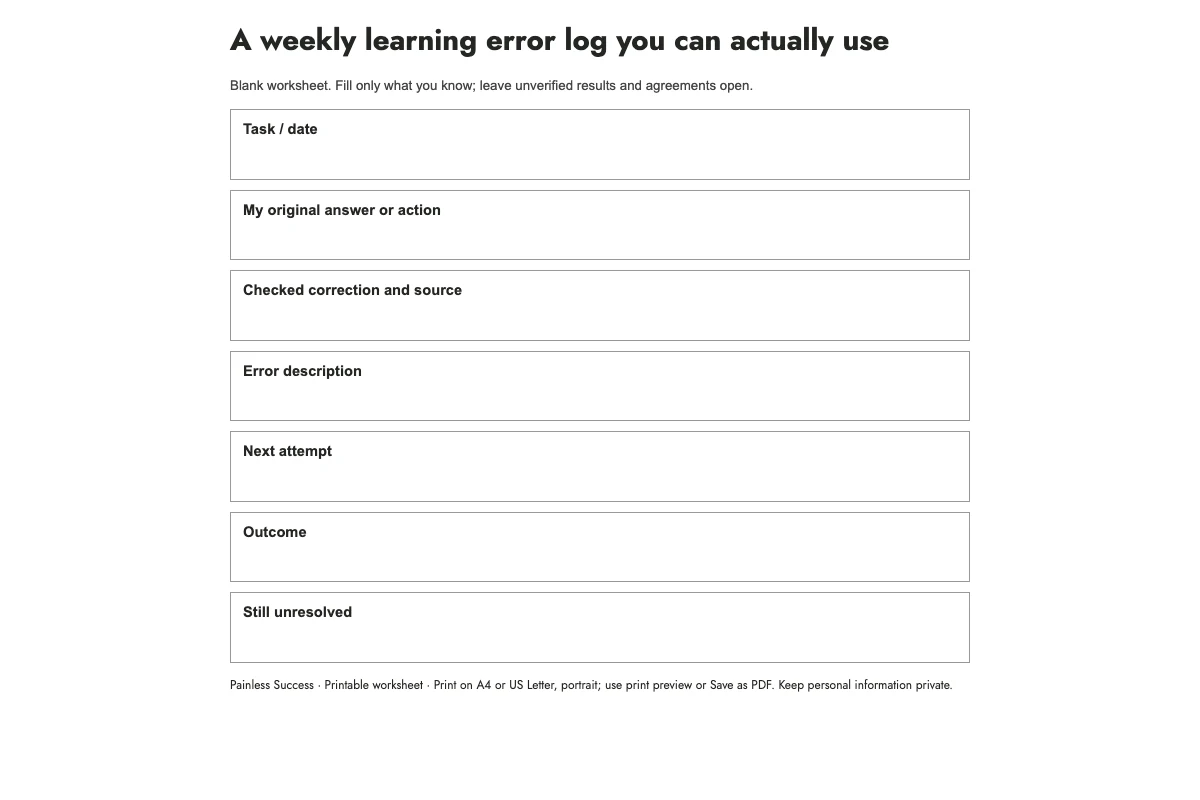
Keep a few errors you want to revisit in a weekly learning log. For each entry, save your original attempt alongside a checked correction and the next attempt you plan to make. AI can help arrange the entries; the records do not establish what kind of learner you are.
In this invented example, a learner writes “turn left at the library” in a map exercise. The answer sheet says “turn right.” The log records “direction copied incorrectly,” with a proposed retry of the route. A second vocabulary answer is blank and has no available answer key. That entry stays unresolved. The map entry is ready for a retry; the vocabulary entry still needs a correction you can check.
Capture the actual error
After a session, keep the smallest piece of evidence that explains the problem. Copy the answer you wrote, note the task number, or describe the step where your result diverged from a checked example. “Bad at directions” is a judgment. “Wrote left where the supplied route says right” is something you can inspect.
If you use photos, make sure the task identifier and your answer are legible. You can keep them locally and write only the relevant text on the sheet. An image full of unrelated work makes later review harder and may include names or information that does not belong in an AI prompt.
Choose a few entries that matter for your next session. Three is a practical starting limit for this worksheet, not a research-backed ideal. If a single error blocks the rest of the task, one entry may be enough. Leave harmless slips alone when recording them costs more attention than correcting them.
Verify before writing the correction
Use the answer key, teacher feedback, worked solution or other appropriate source supplied with the task. Record where the correction came from so you can return to it. If two sources disagree, keep the disagreement visible and ask the person responsible for the exercise.
A confident AI answer is not a substitute for the missing key. OpenAI's accuracy guidance explains that answers can contain errors even when phrased confidently. In this log, an unsupported correction would be particularly unhelpful because you might practice it repeatedly.
Separate a wrong answer from a missing attempt. The vocabulary row in the example is blank. You cannot tell from that alone whether the learner ran out of time, did not understand the question or skipped it accidentally. Write “blank response; reason unknown,” and investigate only if that distinction helps the next session.
Use AI to organize, not diagnose
Try the fictional notes in this prompt first. Check that AI proposes only one next attempt and leaves the unverified answer open as it arranges the entries into columns.
Sort these invented practice records into an error log. Use only supplied evidence. Columns: task ID, original response, checked correction/source, neutral error description, next attempt and unknowns. Do not infer a diagnosis, ability level, motivation or learning style. Do not invent answers or mark retries complete. Suggest at most one next attempt per entry and label it proposed.
E1: Fictional map exercise M2. My answer says turn left at the library. The supplied answer sheet says turn right. I have not retried it.
E2: Fictional vocabulary exercise V4. My response is blank. No answer key or teacher correction is available.
E3: I have time to review one entry next session.
Keep V4 unresolved. Prioritize a retry that has a checked correction; do not fill the missing answer.
Check that the model preserves the source IDs and the word “proposed.” If it labels the first row “poor attention” or the second “weak vocabulary,” replace those interpretations with the observable facts. The records do not establish either conclusion.
OpenAI's prompting guidance recommends providing clear context and revising a prompt after checking the output. If the model keeps over-interpreting, remove the classification request and ask it only to copy the fields into a table. A less ambitious output can be more useful when the evidence is thin.
Plan a retry that can reveal a change
For the map example, cover the correction and attempt the same route again. Compare the result with the answer sheet afterwards. Write what happened rather than awarding a general success mark: “right turn this time, checked M2” describes the evidence.
A correct repeat does not establish that every similar task is now easy. If the skill matters, a later task can show whether the correction carries over. Keep that later attempt separate so you can distinguish remembering one answer from handling another example.
For an unresolved row, ask for the information you need before planning more exercises. “Find the answer source for V4” gives you a clear next task when the correction itself is missing.
Review the week without turning it into a scorecard
At the end of the week, look for a repeated observable pattern. Perhaps several entries involve copying a number incorrectly, omitting a required label or beginning before reading the final instruction. Group them only when the evidence supports the same description.
Choose one change for the next session. You might underline the required output before answering, compare copied numbers once, or ask the teacher to demonstrate the unclear step. Keep the change beside the relevant rows so you can see what it was intended to address.
Do not compare totals between weeks unless the task mix and recording rules are comparable. Ten logged slips in a longer, harder week do not automatically mean performance declined. This sheet is a working record for selecting a next attempt, not a formal assessment instrument.
Retire entries that have served their purpose
Once you recognize the correction, move a resolved example out of the active sheet. If the error returns, add the new task and date so you can distinguish the fresh attempt from the old result.
Use the weekly practice review for the broader question of whether your routine still fits. If you need new exercises after checking a correction, the practice-question workflow covers that separate job. The error log should end with a specific next attempt or a specific unanswered question.
More practical tools
Unstick a task or compare two options. Fill in your own details, then print the result or download your notes.