A borrowed-items log is most useful when one object is really several pieces. “Picnic set returned” sounds complete until you count three plates where there used to be four. Write down the pieces at handover, keep the return plan separate, and close the row only after checking what actually came back.
In this invented example, loan L01 contains one bag, four cups and four plates. Sunday is the agreed return day, but the time is still unagreed. When the set comes back, both people count the bag, four cups and three plates. Keep the row open with one plate unresolved. The missing plate has not been located; the record does not establish that anyone damaged or lost it.
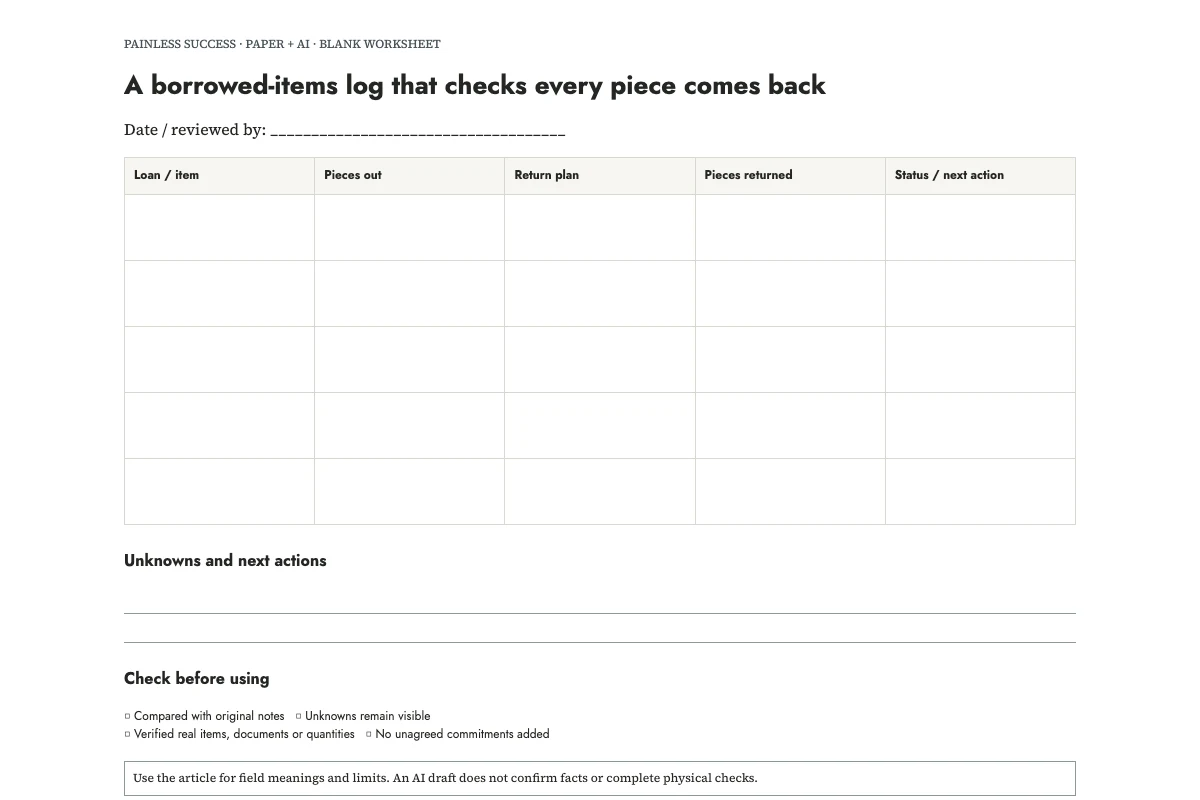
Print the blank log, use the filled example, or save the AI prompt. For a single book, a short note may be enough. Use the fuller sheet when accessories, multiple pieces or several simultaneous loans make memory unreliable.
Describe the loan before it leaves
Give the loan a short identifier such as L01 and a description you can recognize later: “picnic set in green bag” identifies it more clearly than “household equipment.” Count the pieces together when practical, so both people can check the starting record before the item leaves.
Keep counts in separate units. One bag, four cups and four plates is easier to compare than nine pieces, because the total alone can conceal a substitution. For a board game with many small components, agree whether you are checking a supplied contents list or simply handing over an unchecked box. Record which actually happened.
Add only condition notes you can support. “Small mark on outside of bag, observed together” is more useful than “perfect condition.” If no condition check happened, write unchecked. The record should not pretend that every loan began with a detailed assessment.
Write an agreed return plan
Ask when and how the item will come back, then record the answer. A suggested Sunday return becomes an agreement only when the other person accepts it. If the date or time is uncertain, leave the missing field visible and decide when you will confirm it.
The request-to-borrow guide covers the conversation before lending. This sheet begins where that agreement needs a durable record. It does not determine liability, impose new conditions or replace a conversation about an important item.
I would leave contact details off a shared printed log unless someone needs them there. A household nickname or privately understood label may be enough. Before asking AI to format the sheet, replace real names with roles and remove addresses; those details are unnecessary for organizing the loan.
Let AI normalize inconsistent notes
Complete the blank sheet by hand if you have only a few notes. If you use AI to put a longer set into consistent columns, check that it preserves each stage: planned, handed over and physically returned.
OpenAI's prompting guidance recommends clear instructions and reviewing the result. Specify what the model must leave unknown. A request to “make my loans look organized” is less precise than a request for counts and unresolved items.
Format a household loan log from these invented practice notes. Separate agreed plans from completed checks. Use columns: loan ID, item, pieces handed over, return agreement, pieces physically checked on return, status, next action. No invented names, dates, condition assessments or automatic messages. Draft only.
N1: L01 picnic set was handed over with one bag, four cups and four plates. The lender and borrower counted these pieces together.
N2: L01 return day was agreed as Sunday; no date or time is supplied in these practice notes.
N3: At return, one bag, four cups and three plates were counted. The fourth plate has not been located. No condition check is recorded.
N4: L02 board game was lent as a box with contents. Contents were not counted. No return date has been agreed and no return has happened.
N5: Mark L01 open with one plate unresolved; do not call it fully returned. Mark L02 open and contents unknown.
Finish with human checks. Do not treat a missing record as evidence of damage or misconduct. Cite note IDs.
L01 should show eight recorded pieces returned from the nine handed over, with one plate still unlocated. For L02, you have no checked list of the original contents. Keep “contents not counted” even if the model recognizes the game name and offers a plausible component list.
Check the return in the same units
Lay out the returned pieces and compare each kind with its outgoing count: bags, cups and plates. The container coming back is only the start of this check. If you cannot check the contents yet, write “received; contents unchecked” and leave the loan open.
When something remains unresolved, record the next agreed action without assigning blame. In the practice example, that might be “borrower will check the other bag; follow-up time to be agreed.” That proposed action is not part of the supplied notes, so it belongs in a conversation before being added as a commitment.
If an item returns in several visits, add each actual count and date to the same row or continuation sheet. Avoid replacing the original outgoing count with the latest returned count. You need both sides of the comparison to know whether the loan is closed.
Catch three misleading summaries
Watch for “Everything returned Sunday”: one plate remains unresolved, and the actual calendar date is unspecified. “Board game missing pieces” also exceeds what you know because nobody counted the contents. Nor do the notes support “Borrower agreed to replace the plate,” which invents a commitment.
OpenAI's accuracy guidance explains that confident generated text can be incorrect. Review counts, dates and agreement words directly against the notes. The sample is an editorial practice record; it is not evidence of a real loan or a tested AI response.
Close a row when the relevant return checks are finished and any unresolved issue has an agreed resolution. Add a short closure note rather than erasing the history. Review open rows before lending the same set again, so an unresolved piece does not disappear into the next loan. If the difficulty is repeatedly agreeing on return arrangements, use the borrowed-equipment boundary guide before adding more columns to the log.
Sources and scope
This is an original editorial organization method. The cited OpenAI pages support the narrow AI-writing guidance, not measured productivity benefits. Examples are invented. No legal, technical repair, nutrition or food-safety determination is made.
More practical tools
Unstick a task or compare two options. Fill in your own details, then print the result or download your notes.