Draft for editorial review · English · Prepared 29 October 2026 · Not published
Blank printable · Filled example · Complete prompt
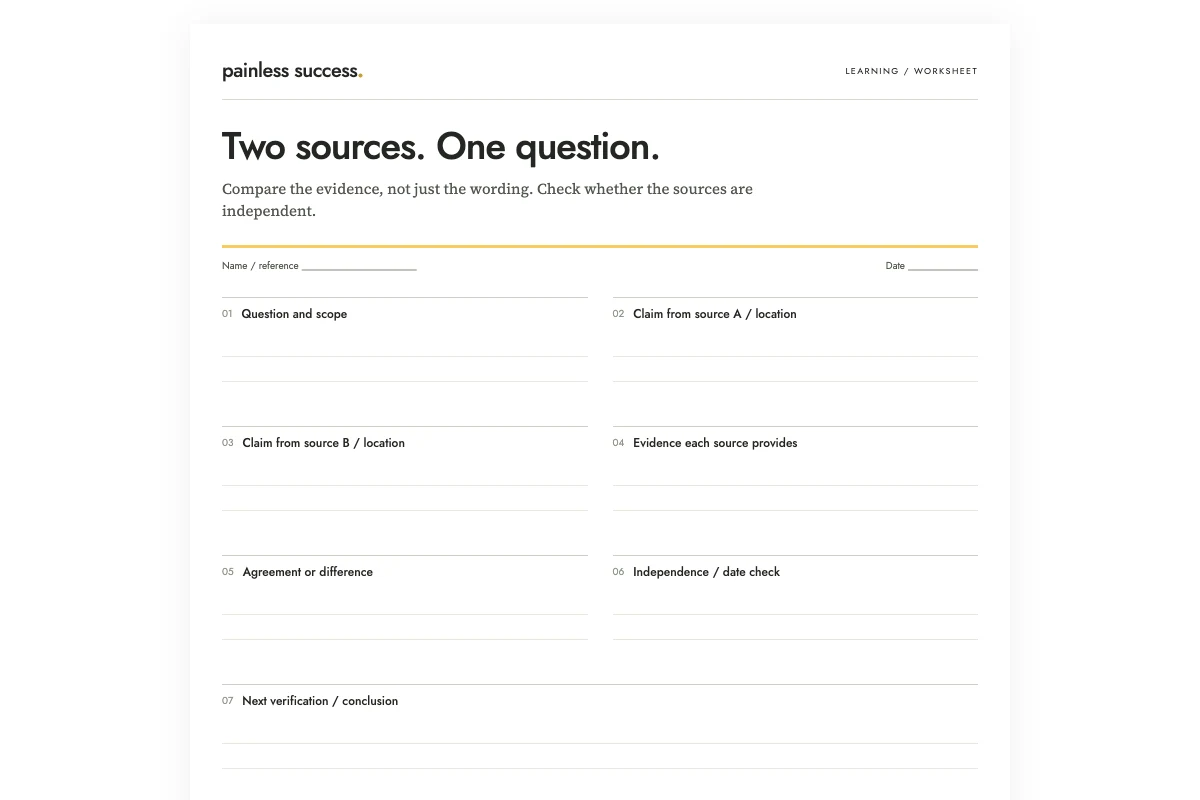
When two sources say similar things, write their claims side by side before treating the agreement as confirmation. Add the evidence each source gives, the date or scope of the statement, and whether one source is repeating the other. A claims-and-evidence table helps you see what still needs checking.
In this invented example, an exhibition organizer’s notice says “Saturday and Sunday.” A visitor guide says “weekend opening” and cites that notice. The two texts appear to agree, but the guide does not supply an independent confirmation. Neither extract identifies the applicable weekend. Before making a trip, you still need the current organizer's schedule.
Start with one question both texts can address
Write the question at the top of the page. “Is this exhibition open on Sunday?” is narrower than “Which source is better?” A source can be useful for one question and irrelevant to another. A visitor guide may describe the route well while relying on someone else for opening information.
Keep the relevant place, time and version in the question when they matter. “Does this rule apply?” is incomplete if the sources describe different years or organizations. If the scope is missing, record the omission. Do not quietly supply it from your assumptions about when the text was written.
You may find that the sources answer different questions. A general introduction and a technical document can describe the subject at different levels of detail without disagreeing. Record that difference before trying to reconcile their claims.
Record claims in small, checkable pieces
Read the relevant passage in each source and write a short paraphrase with its location. Use quotation marks only for exact wording you have checked. Keep the source's qualifications: may, usually, only, except and other limiting words can change the claim substantially.
Avoid copying a paragraph into one cell and calling it evidence. Split it into the claim that matters and the support offered for that claim. “The exhibition opens Sunday” is a claim. “The organizer's dated schedule lists Sunday” identifies a possible basis you can inspect.
Use source labels such as A1 and B1 so you can trace each row. If you later add a third source, give it a new label rather than replacing a disagreeing statement. The record should show how the comparison developed, especially when an earlier source turns out to be outdated.
Ask what supports each statement
A source may refer to a schedule, report, measurement, interview, official instruction or another article. Record the support it actually provides. If no support appears in the material you read, write “not provided in this extract.” That does not establish that no evidence exists anywhere.
Follow a relevant citation to see whether it supports the claim you are checking. A link to a large homepage is less specific than a link to the actual record. If the reference cannot be opened, record that limitation instead of describing it as verified.
In the fictional example, B explicitly relies on A. Counting them as two independent confirmations would count the same notice twice. Record B’s reliance on A in the table and return to A when checking the opening information.
Use AI to organize supplied extracts
Try this prompt with the two fictional texts, then replace them with short extracts you are permitted to share. Check the claims and their support; a source’s name or writing style alone cannot settle this comparison.
Compare the two fictional source extracts below for the question: is the exhibition open on Sunday? Return exact claim/paraphrase with source ID, evidence offered, agreement or difference, dependence between sources, and unresolved checks. Do not treat agreement as proof. Do not infer current opening dates. Do not browse, contact anyone or invent source details.
A1: A fictional organizer notice says the exhibition opens Saturday and Sunday. No publication date or applicable weekend is supplied.
A2: The organizer notice is the stated basis for its own schedule; no separate confirmation is included.
B1: A fictional visitor guide says the exhibition has weekend opening.
B2: The guide explicitly says its opening information comes from the organizer notice A.
Conclude only what the extracts establish. List the next source check needed before relying on Sunday opening.
The expected conclusion is limited: the extracts describe weekend opening, B derives that information from A, and current applicability remains unknown. An answer such as “Sunday opening is confirmed by two sources” loses both the dependence and the missing date.
OpenAI's accuracy guidance explains that generated claims can be wrong even when confidently expressed. Here, the tool's role is to arrange evidence and flag questions. Its conclusion should be checked against the supplied passages, just like the individual cells.
Distinguish disagreement from different scope
When the claims differ, inspect the dates and conditions before deciding that one is false. One source may describe regular hours while another announces an exception. One may include only completed work while another includes planned work. Write those boundaries in the table.
Sometimes the language is genuinely ambiguous. “Weekend” may be enough for a broad overview but insufficient for the decision you need to make. Ask for the explicit day or condition rather than treating a broad phrase as a detailed promise.
If both sources refer to the same event and time but give incompatible facts, retain the conflict. Do not average the statements or choose the newer-looking design. Identify the record or responsible source that could resolve the specific discrepancy.
Write a conclusion no stronger than the evidence
Use separate labels for agreement and verification. “Both texts say X” describes their content. “X is supported by this checked record” describes an additional step. Those statements are not interchangeable, even when the sources sound authoritative.
A practical conclusion can be: “The two texts point to Sunday opening, but both rely on an undated notice. Check the current organizer schedule before relying on it.”
For a low-stakes reading exercise, you may stop after identifying the gap. For a decision with consequences, use an appropriate current authoritative source or qualified help. The worksheet does not make two weak sources sufficient for a high-stakes conclusion.
Keep a useful trail without archiving everything
Save the relevant links, titles, locations and checking date. Keep only the extracts needed to understand the comparison, respecting the material's sharing restrictions. A concise record is easier to update when a source changes than a folder of unidentified screenshots.
Use separating an information request from a decision when you need to ask someone for the missing fact. For organizing the resources that remain useful, see a resource list for one project.
More practical tools
Unstick a task or compare two options. Fill in your own details, then print the result or download your notes.