Draft for editorial review · English · Prepared 29 October 2026 · Not published
Blank printable · Filled example · Complete prompt
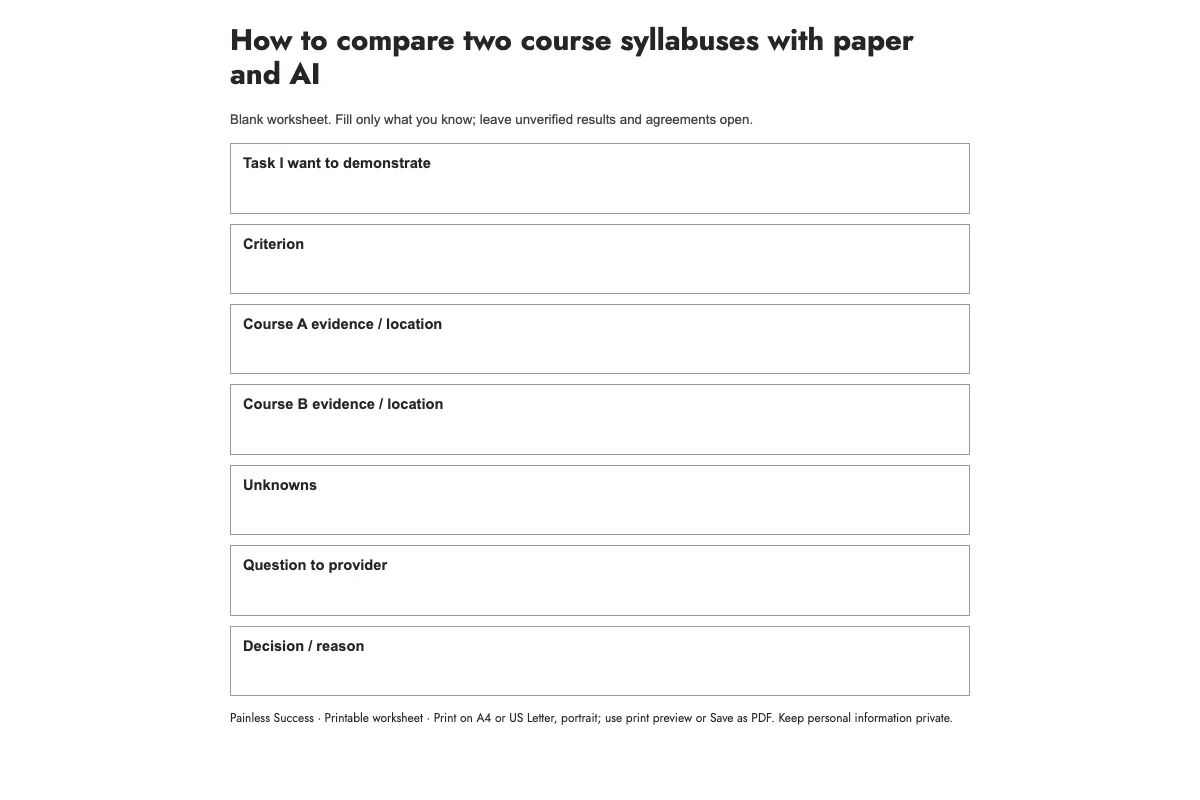
Comparing two course syllabuses is easier when you start with one thing you want to do afterwards. Put that task above a two-column evidence table. Then record what each outline actually promises, where it says so, and what you still need to ask. AI can extract those details from text you provide, but it should not fill gaps with assumptions about the provider.
In this invented example, you want to make a small spreadsheet budget using formulas you can explain. Course A lists basic formulas and weekly exercises. Course B lists basic formulas and two assignments with written corrections. Neither extract gives total weekly study time. You can compare the stated assignments, but still need to ask about workload.
Write the task before collecting more brochures
Use a result you can recognize: create a simple budget, edit a short audio recording, or hold a particular everyday conversation. “Become confident” may describe your hope, but it gives you little to look for in a syllabus. A concrete task helps you decide which topics deserve attention.
Add constraints that genuinely affect attendance or completion. These might include the times you can attend, the equipment you already have, or whether you need feedback on submitted work. Keep preferences separate from requirements. A live discussion may be pleasant without being essential; an unavailable class time may rule out the course completely.
I would begin with no more than five comparison rows. A long scoring sheet can make an uncertain choice look precise. If both courses satisfy the same requirements, the remaining decision may be about convenience or preference rather than a measurable difference in quality.
Capture the exact outline you are comparing
Save or bookmark the relevant syllabus and note the date you checked it. Record the course version or intake if the provider identifies one. Different dates, delivery formats or levels may have different requirements, so do not combine details from separate offerings without checking.
Copy short relevant extracts into your working notes, with source labels such as A1 and B2. Keep the original links on the paper sheet or in an accompanying local note. If you are comparing private course materials, use only material you are permitted to share with the AI service.
Write “not stated in this extract” when a topic or service is missing from the text you read. For B, charts are not mentioned; you have no confirmation that the course excludes them. Keep that qualification even in a shortened comparison.
Ask AI for evidence, not a verdict
Try the fictional extracts in this prompt, then replace them with your checked notes. Include your task and constraints each time so AI compares the courses against what you need.
Compare only these fictional syllabus extracts against my stated task. Make a table with criterion, A evidence and source ID, B evidence and source ID, missing information, and a question to ask. Do not recommend a winner, infer accreditation, invent prices or assume that an omitted topic is absent from the real course. Distinguish stated, not stated and not relevant. Draft only; do not contact providers or enroll.
Goal G1: Create a small spreadsheet budget from supplied figures, with formulas I can explain.
A1: Course A covers entering data, basic formulas and simple charts.
A2: A has weekly exercises. Estimated weekly hours and individual feedback are not stated.
B1: Course B covers data entry and basic formulas; charts are not mentioned in this extract.
B2: B requires prior familiarity with opening and saving spreadsheets.
B3: B includes two assignments with written corrections. Total weekly study time is not stated.
List at most three follow-up questions, prioritized by what would change the decision.
Inspect every filled cell against its source label. For A's feedback row, an acceptable answer is “not stated, A2.” “Weekly tutor feedback” adds a promise that does not exist in the notes. For B's prerequisite row, “opening and saving spreadsheets, B2” preserves the actual requirement.
OpenAI's accuracy guidance warns that generated answers may be incorrect despite confident wording. Treat the table as a draft index to the syllabus. Open the original pages when verifying the details that would affect your choice.
Compare like with like
A provider's live teaching hours may not include assignments or independent practice. If you need the full weekly commitment, ask for that figure explicitly rather than assuming contact time equals total study time. If the information is unavailable, record a range supplied by the provider or leave the field unknown; do not invent your own estimate and attribute it to the course.
Likewise, “includes assignments” and “includes individual feedback” describe different things. Record the stated method: automated checks, written corrections, group discussion or another named process. Do not assume that one is universally better. Match the format to the kind of help you need for your task.
Keep completion certificates, external recognition and entry requirements in separate rows if they matter. The worksheet itself cannot verify a credential. Use the relevant provider or awarding body's current documentation before relying on such a claim.
Turn missing information into short questions
Ask about the gap that could change your decision first. In the filled example: “Does Course A include individual correction of submitted exercises?” is more useful than “Is the teaching good?” For either course, ask: “What weekly time should a beginner allow, including independent work?”
Write the answer with its source and date. An informal answer can clarify a point, but if a condition is essential, ask where it appears in the current course information. Keep an unanswered question open instead of treating silence as agreement.
If neither syllabus fits your task, check whether you need a different level or a shorter introduction. A conversation with the provider may clarify the mismatch before you enroll.
Make the decision in plain language
Finish with a sentence that names the reason and remaining uncertainty: “B fits my feedback requirement; weekly time is still unconfirmed.” Do not write “B is best” when you only compared extracts for one personal task. A weighted score is optional, and it cannot repair missing evidence.
Use questions before a new course for a broader enrollment check. If the intended outcome is still vague, begin with a learning goal you can demonstrate. Keep this sheet with the syllabus so you can later compare the actual experience with what you expected.
More practical tools
Unstick a task or compare two options. Fill in your own details, then print the result or download your notes.