Draft for editorial review · English · Prepared 29 October 2026 · Not published
Blank printable · Filled example · Complete prompt
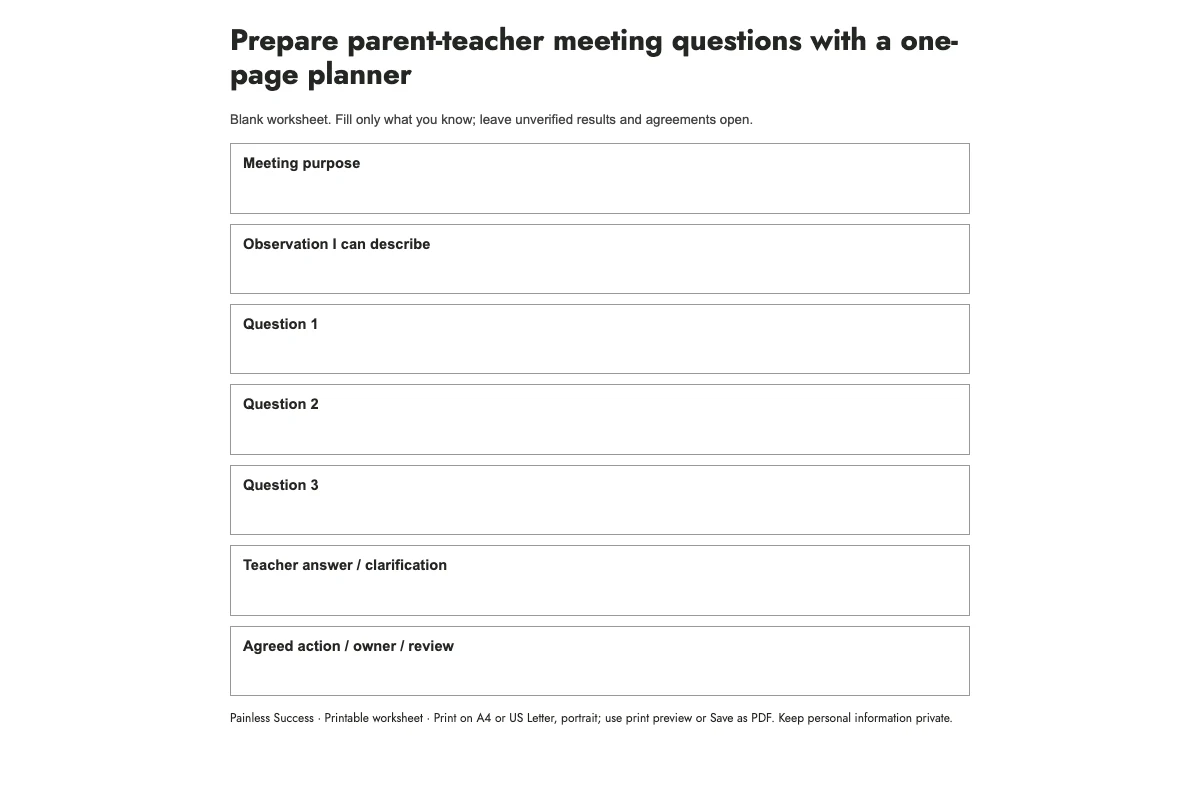
Prepare a few questions you need answered at the parent-teacher meeting. Write the purpose at the top of one page, add a neutral example and leave space for the teacher’s explanation. If you use AI to shorten the questions, give it a fictional or generic description and keep the actual child records out of the prompt.
For example, imagine that the take-home reading instruction is sometimes unclear. Three useful questions are: “Where can we find the current instruction?”, “What should be attempted independently?” and “How should we flag wording we do not understand?” This is an invented practice situation. It does not describe a particular child, teacher or school's policy.
Choose one purpose for the conversation
Start with what you want to understand. “Understand the take-home routine” gives the meeting a direction. “Discuss everything that is going wrong” is too broad for a short conversation and makes it harder to notice when a useful question has been answered.
There may be more than one important issue. Write them down privately, then choose the few that need this meeting. If the available time cannot cover them, ask how to arrange a follow-up. Do not assume the teacher can extend the appointment or answer a long list immediately.
Use this sheet for an ordinary planned conversation. If a concern needs prompt attention, follow the school’s contact procedure without waiting for the routine meeting or finishing the worksheet.
Describe what you observed without explaining it away
A useful observation includes the situation and what was unclear: “We could not tell which passage the instruction referred to.” It does not need a conclusion about motivation, ability or teaching quality. You can ask for the missing context in the meeting.
If you bring a relevant piece of work, check that it is the item you mean and that the date is clear. Keep other children's names and unrelated material out of shared notes. You do not need to upload the work to AI to prepare a question about it.
I would keep the child's exact comments in a private note if they matter to the conversation, and avoid polishing them into a stronger claim. “I did not know which page” is not the same statement as “The instructions are always wrong.” Preserve the difference between what was said and your interpretation.
Draft three questions from a generic example
The prompt below can be used unchanged as practice. For your meeting, you can replace the generic issue without including names, grades, dates of birth, learning records, photographs or other identifying details. If the situation cannot be described usefully without sensitive information, write the questions yourself on paper.
Help draft three neutral questions for a parent-teacher meeting using this fictional, non-identifying practice example. Do not infer a child's ability, diagnosis, behavior or teacher intentions. Do not request names, records, grades, photographs or personal details. Do not invent school policy or agreements. Return three questions, a short purpose sentence and empty fields for answers and agreed actions. Draft only; do not send messages or schedule anything.
N1: Meeting purpose: understand the take-home reading routine.
N2: At home, the fictional task instruction is sometimes unclear. The example does not establish why.
N3: The parent wants to know where to find the current instruction, what the child should attempt independently, and how to flag unclear wording.
Keep questions specific and collaborative. Leave answers and commitments blank.
Check the questions against your purpose. Reject wording that assumes the cause: “Why are the instructions unsuitable?” presumes a conclusion. “Could you show us where to find the current instruction?” asks for something observable and leaves room for an explanation.
OpenAI's prompting guidance recommends clear context and reviewing generated responses. In this task, the review is straightforward: each question should help you understand the routine, avoid an unsupported assumption, and be short enough to ask aloud.
Leave space for answers you cannot predict
Print the blank planner and bring a pen. Leave the answer fields empty so your expectations cannot be mistaken for what the teacher said. The filled example also leaves answers and commitments open because it shows preparation before a meeting.
During the conversation, write the answer in brief phrases. If something affects what you should do at home, check your understanding: “So we should use the instruction in this location, and ask through this channel if it is unclear?” Let the teacher correct the summary before you rely on it.
You do not need a verbatim record of the whole meeting. Focus on the information that changes the next step. If you want to record audio or use a transcription tool, ask about permission and the school's rules beforehand. The paper workflow works without either.
Separate a suggestion from an agreement
A possible action might be “try checking the instruction together before starting.” That becomes an agreed action only when the relevant people accept it. Record who will do what and when the arrangement will be reviewed, if a review is agreed. Do not assign a task to the teacher or child just because it appears in your notes.
If the answer depends on another staff member or a policy check, note what still needs confirming. “Teacher will confirm where the instruction is posted” leaves the location open; keep it that way in your record so you do not treat a promised check as an answer.
OpenAI's accuracy guidance notes that generated text can be wrong. If you use AI afterwards to tidy a generic summary, compare every action and status with your paper record. Do not upload identifiable meeting notes merely to obtain neater wording; a short manual summary is often sufficient.
Review what changed after the meeting
Return to the original purpose and mark which questions were answered. For an open question, write the next contact or check if one was agreed. For an answered question, record the practical change: where you will look, what you will attempt, or how you will ask for help.
Keep the sheet somewhere private and accessible to the adults who need it. Share only the relevant outcome with others rather than circulating the whole conversation. Decide when the note is no longer useful, following any requirements that apply to the records you hold.
For the general structure of a short conversation, see a meeting agenda around one decision. For a question about a specific piece of work, use asking for feedback on one part.
More practical tools
Unstick a task or compare two options. Fill in your own details, then print the result or download your notes.