A 40-hour workweek does not contain 40 hours for new project work. Meetings, routine responsibilities and breaks already occupy part of it. Subtract those commitments before deciding how much extra work to promise.
The calculator uses four inputs: total available hours, meetings and appointments, routine work and breaks, and a reserve you choose. It returns the time left for other tasks. A negative result means the entered commitments exceed the available hours; it is a signal to revise the plan.
Start with this particular week
Enter the hours you are actually available, accounting for leave, shorter days and fixed personal commitments during the workday. Use the same boundary throughout. If lunch is outside your stated working hours, do not subtract it again. If it is inside that total, include it in routine work and breaks.
Check the calendar rather than starting from a standard contract number. A week with a half-day appointment has a different capacity from a week with no absence, even when your role and usual hours are unchanged.
Count work that rarely appears in project estimates
Meetings are easy to see. Preparation, notes and follow-ups can be less visible. Put those minutes in either the meeting total or routine work, and use that choice consistently so nothing is counted twice.
Routine work may include responding to customers, reviewing incoming requests, maintaining a shared file or handling scheduled administration. Use a recent comparable week to estimate these demands. If you have little evidence, label the number as a first estimate and check it against what happens.
Avoid using a single unusually quiet day to forecast a busy week. Likewise, a one-off incident may not represent the next month. Record what made the comparison week unusual before borrowing its figures.
Choose a reserve you can explain
There is no universal reserve percentage in this calculator. Enter time for the uncertainty you expect: late feedback, interruptions, extra review or work whose scope is still unclear. You can also enter zero to see the unbuffered total, but that leaves every additional task competing with an existing commitment.
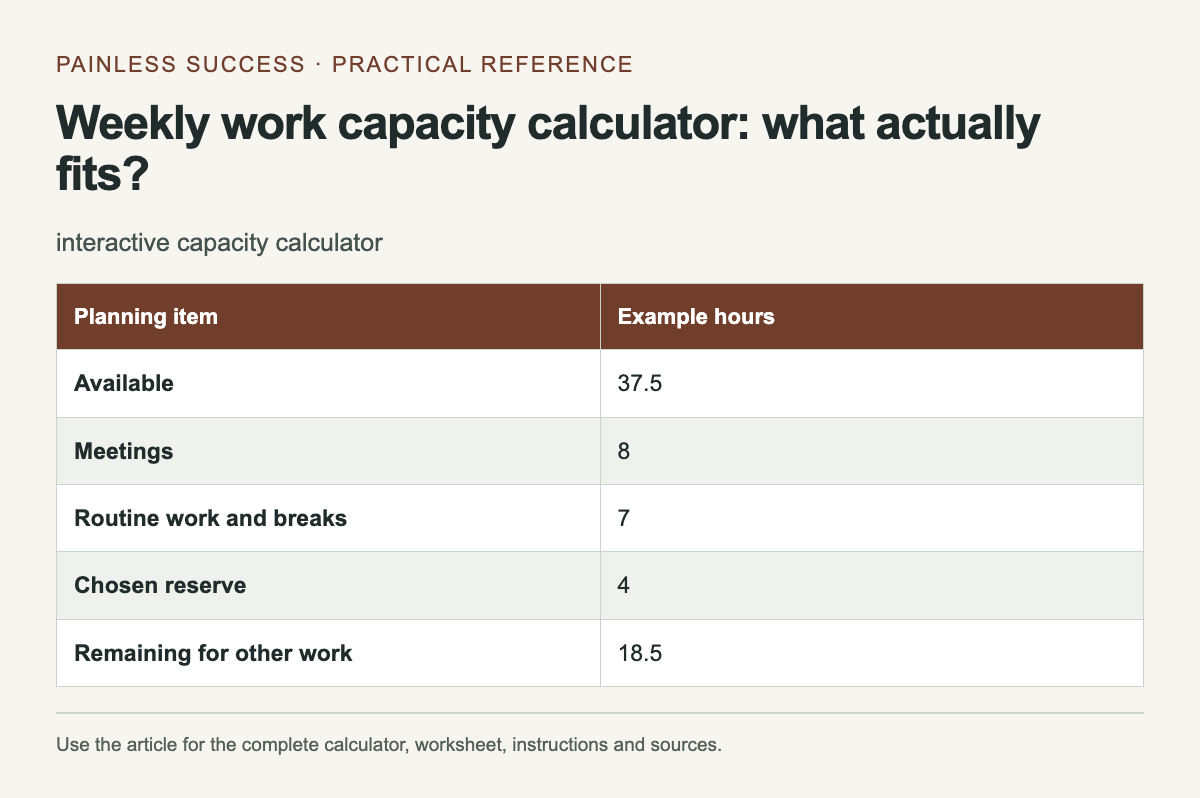
Suppose an illustrative week has 37.5 available hours, eight hours of meetings, seven hours of routine work and breaks, and four hours of reserve. The remaining capacity is 18.5 hours. A project needing 22 hours cannot fit unchanged without moving work, extending the schedule or finding help.
Match capacity with task estimates
List the proposed tasks next to their expected effort. Keep waiting time separate from active work: a two-day wait for approval may use little working time while still delaying the deadline. Include revisions that are reasonably expected, not just the first draft.
When estimates are uncertain, write a range. Three tasks estimated at two to four hours each could require six to twelve hours in total. Check the higher end before making a firm promise, or agree on a smaller first delivery that you can reassess.
Respond to an overloaded result
Take the conflict to whoever can change the priorities. State the available hours and the work competing for them. Ask which deadline, scope or assignment can move. If you control the list yourself, choose what will leave this week's plan and give it a review date.
An hours total also hides the shape of the day. Five spare half-hours may not suit work that needs a continuous two-hour window. After the calculation, check where the remaining time actually falls in the calendar.
At the end of the week, compare your estimate with the time each category used. Adjust the categories that were wrong. The purpose is a better commitment next week, so a simple note about the largest difference is enough to start.
| Planning item | Example hours |
|---|---|
| Available | 37.5 |
| Meetings | 8 |
| Routine work and breaks | 7 |
| Chosen reserve | 4 |
| Remaining for other work | 18.5 |