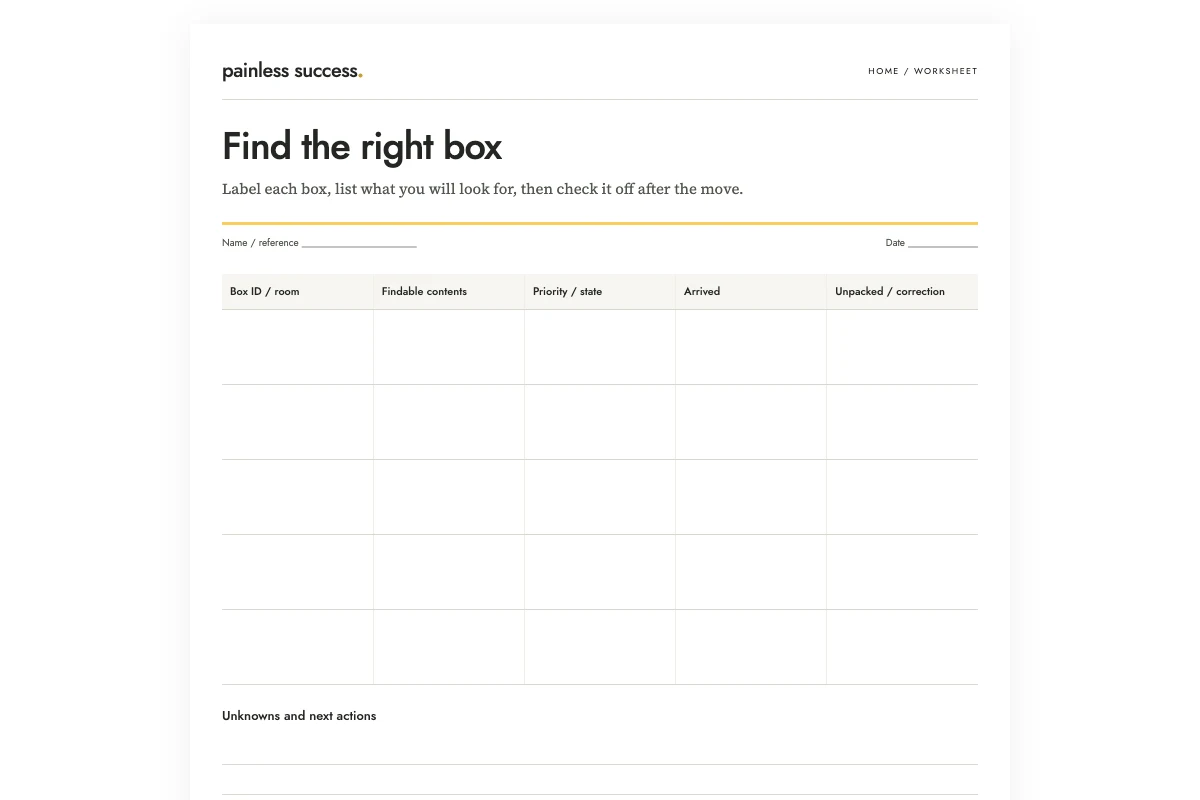
Write B014 on a box, then put B014 beside “study: sketchbooks, blue pencil case, desk trays” on your inventory. The room tells someone where to put the box, while the contents tell you which box to open when you need the pencil case.
In this fictional example, B014 is sealed and marked for early access. B015 also belongs in the study, but contains folders A–F and paper clips and is still open. B016 contains spare pillowcases and fabric storage bags for the bedroom. None has an arrival check yet. Sorting these rows into room order must not change the IDs printed on the boxes.
Open the blank inventory, print the filled practice sheet, or copy the sorting prompt. This is an organization worksheet, not a packing or transport specification.
Give each box one durable identity
Choose a simple numbering sequence and use it throughout the move. B001, B002 and B003 are easy to distinguish without encoding every detail into the label. Write the number on the box when you start its row. Do not reserve a batch of numbers in your head and reconstruct them at the end of the day.
I would keep the room name in a separate field. If you later decide that a box belongs elsewhere, you can change “study” to “living room” without replacing its permanent ID on the box, inventory and related notes.
If two people pack at once, agree how they will claim IDs. They might use separate number ranges or one shared list. Choose the simplest arrangement that prevents duplicates. Before closing a session, check for repeated IDs and for physical boxes with no corresponding row.
Describe contents for a future search
Use words you would actually search for while standing among boxes. “Desk things” gives little help. “Sketchbooks, blue pencil case, desk trays” lets you identify the likely box without opening three others. You do not need to count every paper clip to make that description useful.
Record a distinguishing feature when similar items appear in different places. A blue pencil case and a black pencil case should not both become “stationery.” If the contents are private, use a description that is useful to authorized household members without putting sensitive details on an outside label.
Separate the outside label from the fuller inventory. A room and box number may be sufficient on the box; the private list can hold more detail. Do not paste addresses, access information or personal document contents into an AI prompt just because they appear in the same moving notes.
Track packing, arrival and unpacking separately
Give packing, arrival and unpacking their own fields. Sealing a box prepares it for the next stage; you still need to check its arrival and, later, whether it has been unpacked. Separate fields prevent one tick from standing for all three things.
B015 is still open in the example. If another folder goes in before you close it, update the contents while you can still see them. Keeping sealed, open and unchecked states separate saves you from trying to reconstruct those last additions later.
Mark when you expect to need the contents; “early” and “later” may be enough. You still need appropriate packing and handling for an early-access box. This inventory does not provide those instructions or decide what should travel separately.
Ask AI to sort the record without rewriting reality
Ask the assistant to group your notes by destination room and identify missing fields. It must preserve box IDs and unconfirmed states, without adding things people might typically own. OpenAI's prompting guidance recommends a clear task and revision after checking the response.
Organize these fictional moving-box notes into an inventory. Keep the permanent box IDs. Return columns: box ID, destination room, contents, access priority, packing state, arrival check, unpacking check. Do not guess contents, handling instructions, weights, addresses or completed checks. Mark arrival and unpacking unchecked unless explicitly recorded. Draft only; no purchases, bookings or messages.
N1: B014 goes to study. Contents: sketchbooks, blue pencil case, desk trays. Early access requested. Box sealed.
N2: B015 goes to study. Contents: folders A–F and paper clips. Later access. Box remains open.
N3: B016 goes to bedroom. Contents: spare pillowcases and fabric storage bags. Later access. Box sealed.
N4: No box has a recorded arrival or unpacking check.
N5: Sort for the review sheet by destination room, then early access before later access. Do not renumber boxes when sorting.
After the table, list questions for a person to verify. Cite the note IDs in a final source column. Treat this as an invented planning exercise, not an observed move.
Compare the result with the original three rows. B014 must remain the early-access study box. B015 must remain open. B016 must still contain pillowcases rather than a guessed set of bedding. The assistant may reorder rows, but it must not renumber them or add arrival ticks for a cleaner-looking table.
Reconcile the paper with the boxes
When checking arrival, find the printed ID before marking its row. For a box you cannot locate, write “not located at this check” and note where you searched. That leaves a useful starting point for the next search without treating the box as confirmed lost.
If a box arrives in a different room, you can record its actual location without erasing its intended destination. “Expected study; currently hallway” is a practical search clue. When you later move it, correct that temporary location. Avoid marking it unpacked simply because it reached the intended room.
OpenAI's accuracy guidance cautions that convincing answers can contain mistakes. For an inventory, verify labels and contents against the physical record. This article's example was prepared editorially; no real move or AI test run is being reported.
Keep the list small enough to use
Add a continuation page before the sheet gets too crowded to read. Repeat the columns and the move or batch label so you can put loose pages back in order. Leave enough space to write contents legibly.
If you only need a short outing list, use the day-trip checklist instead. If uncertainty concerns who will check arrival or unpack a shared room, have the household-task conversation before allocating names in the inventory. Finish the first page by asking another household member to find one item using only its row and box label. Their search will show whether your descriptions are useful.
Sources and scope
The workflow and practice records were created for this article. OpenAI references support only the stated prompting and accuracy points. They do not establish measured benefits or validate the worksheet. Apply actual recipient, seller or manufacturer instructions where relevant; fictional examples establish none of those requirements.
More practical tools
Unstick a task or compare two options. Fill in your own details, then print the result or download your notes.