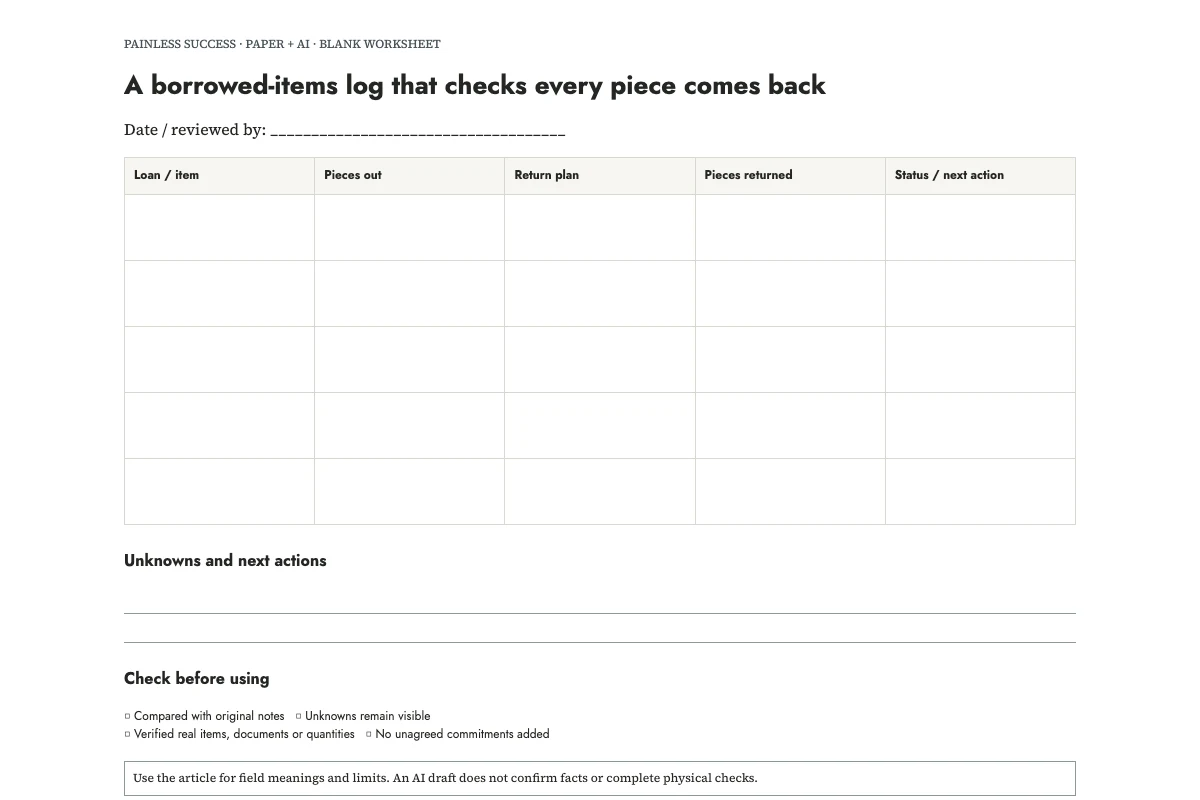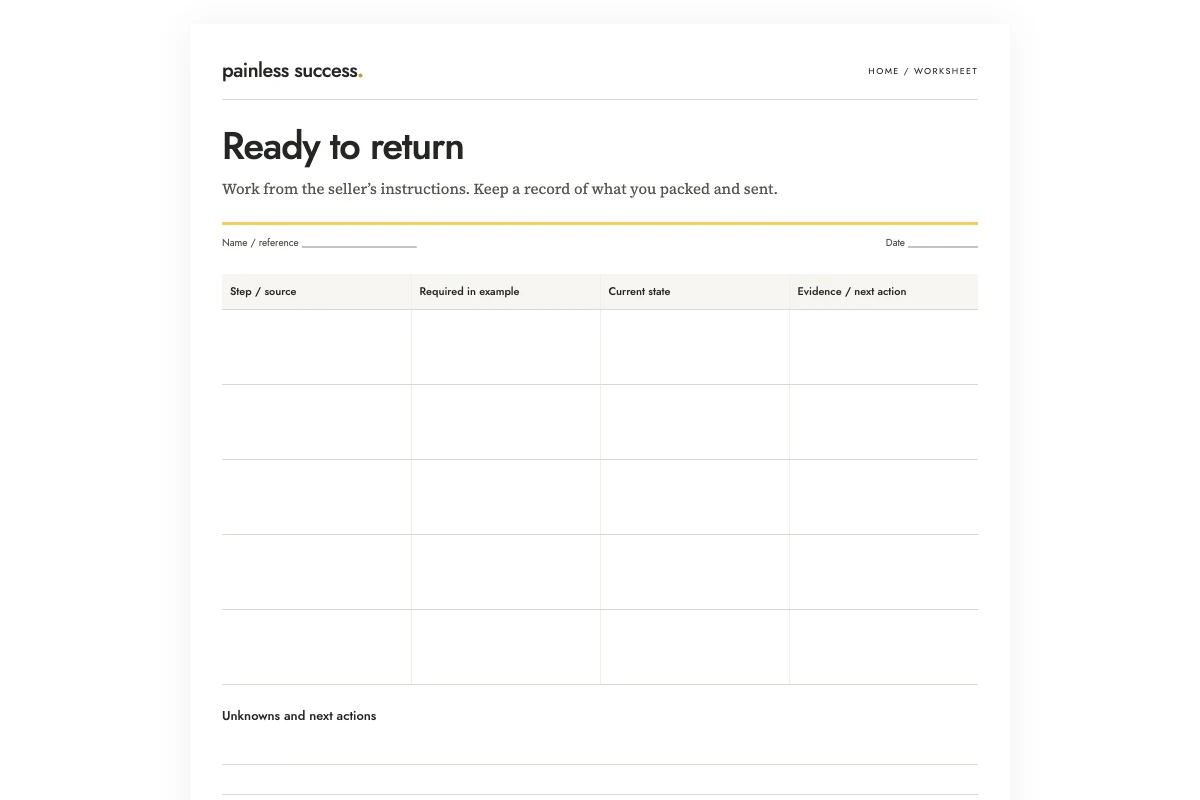
Build the checklist from the instructions for your particular return. Give the item, reference, required documents and dispatch method their own lines, and mark each step when you complete it. Keep deadlines, label rules and promises out of the sheet unless they appear in the seller's instructions.
Here is a fictional example. A seller's invented instructions identify a blue desk organizer from order ending 482. They ask for reference slip R-482 inside the package and a supplied label outside. The owner has printed the slip but has not packed it. The label is available but not applied. The full instructions describe a carrier method that has not been copied into the notes. The return is still in preparation.
Print the blank return sheet, inspect the filled example, or download the prompt. These sample requirements belong only to the invented scenario. They are not a template for any particular seller's policy.
Find the instructions that apply to this return
Open the actual return confirmation, account page or other instructions the seller provided for your item. Check that you are looking at the right order and the current return record. A saved instruction from an earlier purchase may look familiar while referring to a different item or method.
Keep the original instructions beside you as you build the checklist. Preserve each relevant condition and note where it appears. Labeling paragraphs S1, S2 and S3 lets you trace a checklist line back to the seller's wording and distinguish it from a step you added.
This article does not decide whether you can return an item or what rights, costs or deadlines apply. If those are unclear, resolve them through the appropriate seller or authoritative source before using the sheet as an execution plan. For deciding what to assess while a return option is available, read the return-window guide.
Match the physical item before packing
Compare the item with the relevant order details. Use the information needed to distinguish it: description, variant or reference as supplied. If several similar products are on your desk, do this before putting one into a container. A correct label does not fix a mistaken item selection.
List the components and documents required by your actual instructions. The fictional reference slip in this article does not establish a requirement for your return. Keep every requirement you have verified, even if its purpose is not obvious to you.
Keep questions separate from completed checks. “Does this accessory need to be included?” belongs in an unresolved section until you obtain a relevant answer. The AI assistant should not decide from a generic idea of what normally comes with the product.
Distinguish ready from done
The slip is printed and the label is available in the example, but neither has been put where it belongs. Both packing steps remain open. Even after you pack the item, handoff is a separate action that still needs to happen.
Add a state column if a checkbox leaves too much unclear. Ready, pending clarification and completed describe different stages. A tick beside “slip” after printing could be mistaken for proof that it is inside the package, so name the action you mean to complete.
Follow the actual packing and carrier instructions for the item. This worksheet does not supply technical packaging rules or decide whether a product needs special handling. If the method is missing from your copied notes, return to the original instead of asking the model to fill the gap from memory.
Convert the instructions into a source-linked sequence
OpenAI's prompting guidance recommends precise requests and improving an answer after review. Ask for the supplied steps and their sources. You can use redacted instruction excerpts; account credentials, payment details and unrelated order information are not needed for this drafting task.
Create a return preparation checklist from these fictional seller instructions and owner notes. Use only supplied requirements; retain source IDs. Do not infer legal rights, return eligibility, deadlines, postage responsibility, carrier rules, packaging methods or refund timing. This is a documentation exercise, not advice about a real seller. Draft only; no submission, purchase, booking or account access.
S1: Fictional seller instruction identifies a blue desk organizer from order ending 482.
S2: Fictional instruction says include reference slip R-482 inside the package.
S3: Fictional instruction says use the supplied return label on the outside.
S4: Fictional instruction says follow the carrier method in the full instructions. That method is not included in these notes.
N1: Owner has matched the organizer to the order. Slip is printed but not packed. Label is available but not applied.
N2: No packing completion, handoff, delivery, receipt by seller or refund has been recorded. No deadlines have been supplied.
Return columns: step, requirement, source, completion state, missing check. End with unresolved items to read in the original instructions. Keep all unfinished checkboxes empty.
The carrier method belongs on the unresolved list because it is missing from these notes. Check that the table has not selected a service, added a drop-off location or calculated a deadline. “Send tomorrow by standard post” would be an unsupported instruction.
Make one final comparison before handoff
Place the checked sheet beside the full instructions and the prepared package. Read each requirement against the actual state. Is the correct item present? Are the required materials included? Does the label or other dispatch method correspond to this return? Have you resolved the conditions you marked as missing?
I would do this comparison after preparing the package and before treating it as ready to leave. If a step cannot be verified without reopening or revisiting something, leave it unresolved until you have enough evidence. Do not ask the model to certify work it cannot observe.
If the instructions specify evidence to retain, record where you have stored it. You may also keep a private note of the actions you took. Neither a photograph nor this worksheet by itself establishes that a seller has accepted a return or approved a refund.
Record the stages after dispatch accurately
At handoff, write the actual date and any evidence you really receive. Do not prefill a tracking reference or mark delivery before checking its status through the relevant source. Keep handoff, carrier delivery information, seller acknowledgement and refund status as separate entries if you track them.
OpenAI's accuracy guidance notes that confident output can still be wrong. Trace each requirement to the instructions and each completion claim to something you checked. This sample is a review exercise; no real transaction or AI-completed return is being reported.
Store the checked instructions and later records under names you can find again; the personal-document filename guide can help. Close the preparation task once you have completed its requirements. Track later stages separately so a packed box is not recorded as a finished return.
Sources and scope
The workflow and practice records were created for this article. OpenAI references support only the stated prompting and accuracy points. They do not establish measured benefits or validate the worksheet. Apply actual recipient, seller or manufacturer instructions where relevant; fictional examples establish none of those requirements.
More practical tools
Unstick a task or compare two options. Fill in your own details, then print the result or download your notes.