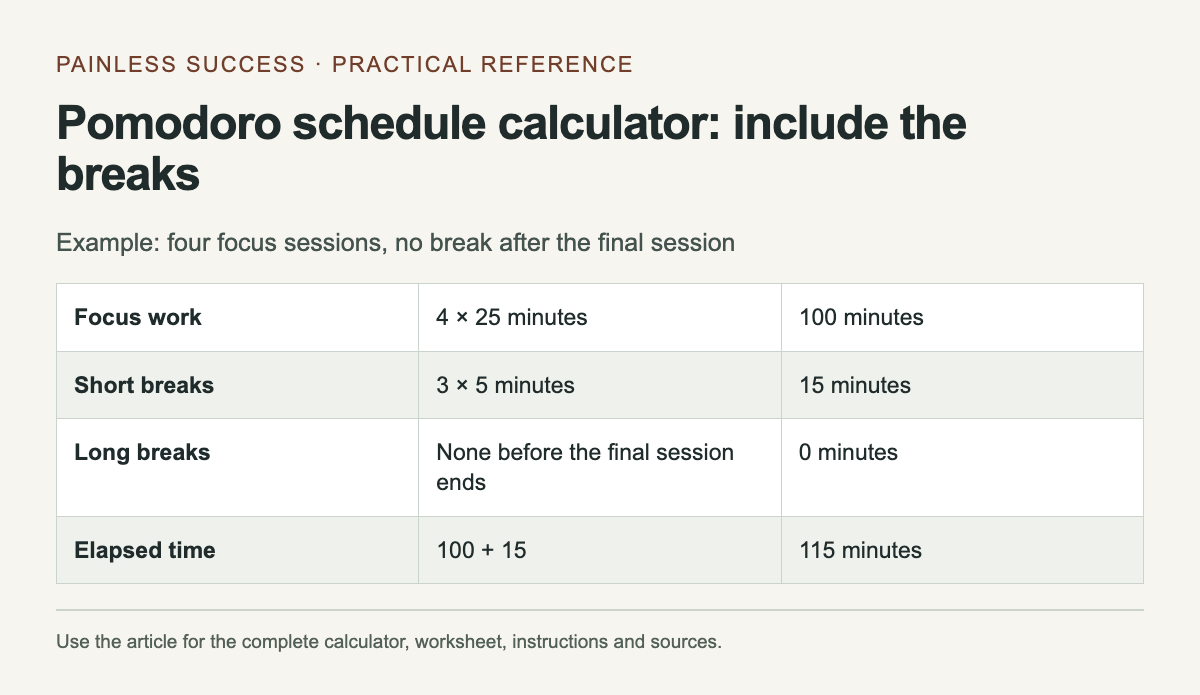
Four 25-minute focus sessions contain 100 minutes of work. With a five-minute break between each of those sessions, the elapsed time is 115 minutes. That difference matters when you only have an hour before an appointment.
Use the calculator to plan a run of sessions. It includes breaks between sessions and leaves out a break after the final one. If you want recovery time afterward, add it to your calendar separately. The result is a schedule estimate; it does not predict how much work you will finish.
Choose the work before starting the timer
Name the action you intend to attempt in the first session. "Draft the reply using the three questions in the message" gives you somewhere to start. "Catch up on everything" makes the first few minutes another planning exercise.
Gather the file, notes or materials you need. If you discover that essential information is missing, decide whether the session should become a preparation task. Spending the whole interval waiting for a reply will not make the original estimate more accurate.
The Pomodoro Technique was developed by Francesco Cirillo. Its official description includes planning, handling interruptions and reviewing effort, as well as timed work. The calculator here covers the scheduling arithmetic only and is not an official Pomodoro product.
Understand which breaks are counted
The default inputs are four sessions of 25 minutes, short breaks of five minutes and a longer break of 15 minutes after every four sessions. A longer break replaces the short break at that point. It is counted only if another session follows.
For five sessions, the schedule contains 125 minutes of focus, three short breaks and one long break: 155 minutes altogether. For eight sessions, it contains 200 minutes of focus, six short breaks and one long break: 245 minutes. There is no second long break in that result because session eight ends the plan.
These are editable planning values. They are not a claim that everyone should work in 25-minute intervals. Use a duration that fits the task, any agreed work arrangements and your need for breaks.
Keep a usable record of interruptions
If an interruption needs immediate action, pause or end the work session. Record roughly where you stopped and what remains. You can then choose a fresh session or a shorter return window without pretending the original plan happened unchanged.
For a nonurgent thought, a short note may be enough: "check appointment time after this paragraph." Keep the note somewhere you will actually review. A growing list of distracting ideas still needs a later decision about whether any of them matter.
Set up a timer you already have
A kitchen timer or phone timer can handle a single interval. Windows Focus also supports a session duration and optional breaks, according to Microsoft's support documentation. If you use an app, check its break behavior before assuming it matches this calculator's convention.
Give the break a simple boundary, especially if you tend to open an activity that is difficult to stop. You might leave the desk and refill a glass of water. Adapt breaks to your circumstances; the calculator cannot assess what rest or movement is appropriate for you.
Review one completed run
After a run, note the number of sessions you attempted, the work that reached a usable state and any interruption that changed the plan. Compare elapsed time with the window you reserved. If the next appointment felt rushed, include transition time next time.
Keep the task estimate and session count separate. Finishing three intervals proves that time passed. Finishing a draft you can send gives you evidence about the work. Use that distinction when planning the next attempt.